
Minnesota Water Pros blog
Minneapolis, Minnesota · Local service informationDoes a City-Softened Minneapolis Home Need Extra Water Treatment?
Published October 22, 2026 · 12 min read · Educational content only, not a water quality diagnosis.

In this guide
- The municipal starting point matters more than a generic Minnesota hard-water label.
- A hardness test answers a different question from a taste comparison or contaminant analysis.
- Kitchen filtration can be evaluated without committing to treatment for showers and laundry.
- Existing equipment deserves an inspection before a replacement or additional stage is proposed.
- Installation, maintenance, verified performance, and total ownership costs belong in the same decision.
What EWG's Tap Water Database Shows for Minneapolis
The Environmental Working Group (EWG) compiles utility testing results supplied by the Minnesota Department of Health. Its listing for the Minneapolis water system, which EWG shows serving about 425,300 people from surface water with data from 2015 to 2024, reports 19 contaminants detected, 10 of them at levels above EWG's health guidelines. The largest gaps EWG lists are Haloacetic acids (HAA9) (about 340 times the guideline), Haloacetic acids (HAA5) (about 154 times the guideline), and Total trihalomethanes (TTHMs) (about 112 times the guideline). Several of the listed items are disinfection byproducts, which form when the chlorine that keeps water safe in the pipes reacts with natural organic matter. We reviewed this listing on October 22, 2026, and you can read the full breakdown on [EWG's Minneapolis page](https://www.ewg.org/tapwater/system.php?pws=MN1270024).
Context matters. EWG's guidelines are its own health benchmarks and are often far stricter than federal legal limits, and many of the listed substances have no legal limit at all. For the most recent quarter EWG reports from the U.S. EPA (April to June 2024), this system was in compliance with federal health-based drinking water standards. Utility data describes the public supply, not the water at your tap, so it is a starting point for a conversation rather than a verdict on your home. If any listed item matters to your household, match it to equipment certified to reduce that specific substance, and compare the Minneapolis and St. Paul snapshots on our water quality page.
Start with what Minneapolis already does
Minneapolis draws its municipal supply from the Mississippi River. Its published treatment description includes softening, filtration, disinfection, and finishing steps. The city's separate water-softening notice says it has softened drinking water since the 1940s and tells residents they do not need to install their own water softener. That is important context for anyone who has moved from a groundwater community, inherited basement equipment, or received an advertisement suggesting every Minnesota household needs the same treatment package. A statement about regional geology is not a substitute for the process your utility already operates. The sensible starting position is not to buy additional softening unless a specific, measured household goal supports discussing it further.
Municipal softening does not mean every dissolved mineral has disappeared. It also does not tell you whether you personally prefer the taste at your kitchen tap. Those are separate questions. Review the city's current report, note its reporting period, and ask the utility about hardness if that is your concern. Do not treat a citywide annual report as a laboratory result from your own faucet, and do not interpret a household preference as evidence that municipal treatment has failed. Our Minneapolis service-area overview provides a local planning starting point, while the broader hard-water versus soft-water guide explains the vocabulary without deciding what your address needs.
Turn a vague complaint into a useful question
Before shopping, write one sentence describing the change you want. Perhaps glasses develop a film after the dishwasher, coffee tastes different from water served elsewhere, or the inherited softener consumes salt without an obvious benefit. Those observations deserve investigation, but they do not identify the cause. Dishwasher settings, detergent amounts, rinse aids, glass etching, plumbing conditions, and residual minerals can produce different problems that look similar. A sales demonstration showing residue after evaporation cannot identify every substance in that residue. Clear water is not proof of safety, and visible residue is not proof of a health hazard. Keep appearance, taste, equipment operation, and health-related questions in separate columns.
Next, record where the concern occurs. Compare the kitchen cold tap with another cold fixture, and note whether hot water behaves differently. Check whether a refrigerator filter, an old under-sink unit, or a basement treatment stage already affects one sample. Do not bypass equipment casually if its purpose is unknown. Read labels, locate manuals, and ask a qualified professional to identify the treatment path when necessary. If the issue is sudden discoloration, an unusual new odor, a utility notice, or suspected contamination, contact the utility and follow public-health instructions rather than conducting a recreational taste test. Routine preference comparisons are only appropriate when there is no reason to suspect a water-quality incident.
Measure hardness without turning the test into a verdict
For a hardness question, use a suitable hardness test kit or an independent laboratory and record the units. A result in grains per gallon cannot be compared directly with a number in milligrams per liter without checking the reporting basis and conversion. Ask whether the sample came from an untreated household inlet, an existing softener outlet, or a fixture supplied through mixed plumbing. A result after treatment describes that treated stream, not necessarily the water entering the home. Repeat an unexpected finding before sizing equipment around it. When samples disagree, plumbing mapping and careful retesting are often more useful than immediately adding a tank.
The Minnesota Department of Health explains that softening is a personal choice rather than a requirement. Its guidance discusses hardness above seven grains per gallon, or about 120 milligrams per liter, as a level at which a household might consider softening. That is not a mandate, a Minneapolis hardness claim, or a statement that water below or above that value is safe or unsafe. Use the measured result alongside appliance instructions and the actual problem you want to address. A conductivity or total dissolved solids meter does not replace a hardness test because it responds to dissolved ions more broadly. Nor does a hardness result substitute for testing a specific contaminant when that is the question.
Choose the category that matches the job
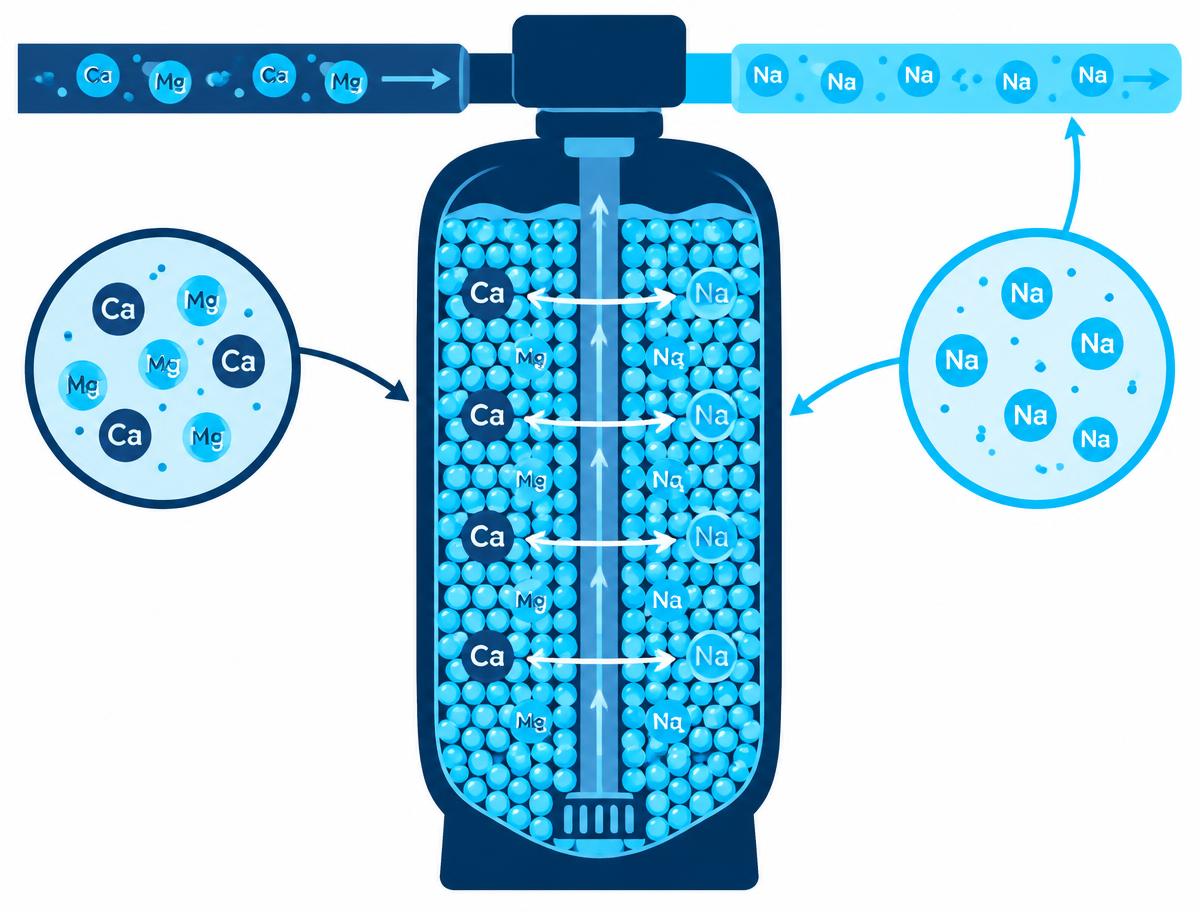
A conventional ion-exchange softener reduces calcium and magnesium associated with hardness. It does not disinfect water and should not be described as a universal drinking-water filter. If the only concern is an occasional taste preference, another softener is a poor default response. The guide to how a water softener works describes resin and regeneration. In a city-softened Minneapolis home, those explanations help you evaluate an existing device critically rather than assume its presence proves that it remains necessary. Household treatment should solve a defined problem, not simply duplicate something the city already does at scale.
Carbon filtration belongs in a different comparison. A point-of-use carbon system can be evaluated for a documented taste-and-odor reduction goal at one tap. A main-line carbon system can be evaluated when the goal genuinely extends to multiple fixtures. Media type, contact time, rated flow, capacity, and the utility's treatment chemistry all matter. Do not assume that every cartridge labeled carbon has equivalent performance or that removing a taste guarantees removal of an unrelated substance. Compare the actual model's performance documentation. The chlorine-in-tap-water article provides useful background, but neither a category description nor an illustration can replace the specification sheet for the equipment being considered.
Consider a kitchen-only change before changing every fixture
Reverse osmosis, usually shortened to RO, is commonly considered for a dedicated drinking-and-cooking faucet. It uses a membrane with supporting stages and produces a reject-water stream during normal operation. Depending on the exact system and its documented claims, it may address particular dissolved substances that an ordinary taste-and-odor cartridge does not. That does not make RO mandatory, does not establish that your water contains those substances, and does not mean every RO model offers identical reductions. If your household wants a different drinking-water profile but has no shower or laundry complaint, a kitchen discussion can stay separate from the main-line discussion.
Compare a simple carbon option with RO using the same household tasks: filling drinking bottles, making coffee, preparing soup, and supplying ice if a refrigerator connection is proposed. Check usable output, storage recovery, inlet-pressure requirements, cabinet dimensions, and filter access. Some tankless configurations need electrical power; tank systems need storage space and a practical service route. Refrigerator compatibility should be verified rather than promised, especially where tubing runs are long or appliance pressure requirements are restrictive. The existing reverse-osmosis-versus-carbon-filter guide can help frame those questions. Neither option should be selected solely because its equipment photograph looks more comprehensive or its stage count is higher.

Read reduction claims as specific claims
Ask for the exact model number, replacement cartridge identifier, performance data sheet, and relevant certification listing before accepting a reduction statement. A certification mark is meaningful only in connection with what that model was evaluated to do. Aesthetic taste-and-odor claims and health-related reduction claims are not interchangeable. Check rated capacity, flow, operating pressure, temperature limits, and replacement instructions because performance depends on using the equipment within its stated conditions. A broad phrase such as certified filtration is not enough to establish a particular result. If a salesperson provides a percentage, ask what substance, test conditions, usable capacity, and operating limits that percentage describes.
PFAS deserves the same precision. Do not infer that a softener removes PFAS, that any carbon cartridge does so, or that every RO system has the same relevant claim. If PFAS is a specific concern, consult current utility and public-health information, then compare the exact substances covered by the model's documented performance. Laboratory results, when appropriate, should come from a suitable accredited laboratory and follow its sampling instructions. Taste, odor, a dissolved-solids reading, and an installer demonstration cannot establish a PFAS result. Treatment equipment also does not replace utility notices or emergency guidance. Keep the reason for choosing a system attached to evidence that can actually support that reason.
Inspect inherited equipment before paying to replace it
An existing Minneapolis home may have a softener installed by a previous owner for reasons that are no longer clear. Photograph the label, note the approximate installation date if documented, and collect service records. Determine which fixtures it supplies and whether outdoor connections bypass it. Check whether the controller's settings reflect measured incoming hardness or an old assumption. A device can consume salt and water while offering little benefit for the current household's goals. Conversely, an apparent lack of benefit does not prove the equipment is broken. Inspection, hardness measurements on the appropriate sides, and a discussion of the original purpose are more informative than judging by tank age alone.
Do not disconnect or abandon equipment without a plumbing plan. A professional should review bypass operation, shutoff condition, drain connections, and whether removal leaves safe, serviceable piping. If you retain a softener, understand regeneration settings, salt requirements, and how to recognize a salt bridge or a service fault using its manual. The state softening guidance also discusses sodium addition, environmental chloride impacts, and possible corrosion concerns. Those tradeoffs are reasons to avoid unnecessary treatment, not grounds for a blanket claim that every softener damages plumbing. If sodium intake is medically relevant, ask your clinician about your needs and evaluate drinking-water arrangements using actual system information rather than a generic promise.
Plan around the house you actually have
Minneapolis includes compact kitchens, larger utility rooms, and many different remodeling histories. None of those descriptions tells an installer where your main shutoff is or whether there is room to service a cartridge. For a main-line proposal, identify the incoming line, meter, shutoffs, water heater, existing treatment, electrical supply if needed, and an appropriate drain route when required. Provide photographs with measurements, not just a wide room image. Ask about bypass valves and how untreated water will remain available during servicing. Clarify which branches would be included and which, such as irrigation or exterior taps, might reasonably stay outside treatment.
For kitchen work, check sink materials, faucet openings, disposal placement, drawers, pullout bins, and access to cold-water connections. A cabinet that fits the equipment may still lack room to remove a housing or replace a membrane. A new drain connection must meet applicable requirements, including backflow protection and any required air gap. Ask who handles plumbing work, permits if required, countertop drilling, and cleanup. Existing leaks, failing valves, and questionable piping should be identified before installation day. Adding treatment is not a repair for unrelated plumbing defects. A clear scope prevents an apparently simple filter project from becoming a surprise kitchen or basement reconstruction.
Budget for a measurable outcome, not the largest package
Use the pricing page for current published cost guidance rather than importing a number from an old article or another household's installation. Request a written scope that separates equipment, installation, required plumbing changes, startup, and optional connections. Include future cartridge or media replacement, salt where relevant, service labor, and the water used for regeneration or RO production. Ask what routine maintenance you can perform and what requires professional attention. There is no responsible universal savings promise: costs depend on actual use, source water, equipment settings, maintenance, and the alternative you are comparing. A smaller system can be the better fit when it addresses the only outcome you care about.
A sensible decision can also be to keep the municipal water as delivered. That option should remain on the comparison sheet, especially when there is no measured hardness problem and no specific drinking-water preference. If you do choose treatment, define success before installation: perhaps a documented hardness target for a retained softener, a preferred kitchen taste, or a named reduction claim supported by an appropriate verification plan. Recheck operation after startup and keep maintenance records. Explore product categories before comparing individual units, and use the contact page to review available contact details and prepare questions. Do not assume an on-page form has delivered an inquiry or that a requested appointment is confirmed.
A practical first-month routine
- During the first week, save the current utility report and identify any existing household treatment. Record your concern in plain language and map which fixtures are affected.
- In the second week, obtain the relevant measurement, such as hardness, without adding unrelated tests simply because a sales package includes them.
- In the third week, compare no added equipment, a kitchen-only option, and a main-line option only if each actually addresses your goal.
- During the fourth week, review written specifications and total maintenance responsibilities. A deliberate month is often more useful than buying immediately after a dramatic demonstration that does not answer your original question.
After any installation, keep the manual, model identifiers, warranty terms, commissioning notes, and initial measurements in one folder. Put replacement reminders on a calendar and track actual usage where the system provides a meter. Inspect accessible connections periodically for leakage and follow the manufacturer's shutdown instructions if a problem appears. Revisit settings when household occupancy changes or plumbing work alters the treatment path. Success is not the number of tanks installed. For a city-softened Minneapolis home, success is understanding what the city already provides and making only the additional change that your household can explain, maintain, and verify.
Sources and further reading
Reviewed October 22, 2026. Utility reports describe the public supply, not an individual household sample. Check the utility for current reports and notices. Images are illustrative, not photographs of a customer installation.
Frequently asked questions
Does Minneapolis city water mean I can never use a home softener?
No. The city's guidance is that its municipal softening means residents do not need their own softener. An unusual household goal can still be discussed using measured hardness, appliance requirements, and the full tradeoffs. That is different from recommending extra softening routinely or claiming every Minneapolis home benefits from it.
Will carbon filtration soften my water?
An ordinary carbon filter is not a conventional hardness-removal system. It may be appropriate for a documented taste-and-odor goal, but calcium and magnesium reduction requires a different treatment discussion. Verify the exact model's claims instead of assuming every device advertised as a filter performs the same job.
Are white spots enough to justify buying treatment?
No. Spots and films can have several causes, including residual minerals, dishwasher operation, detergent use, and glass damage. Measure hardness and inspect the pattern before choosing equipment. Appearance is useful for defining a complaint, but it is neither a complete water analysis nor a reliable water-safety test.
Can I get different drinking water without treating showers?
Yes. A point-of-use carbon or RO system can be considered for a kitchen tap while other fixtures remain unchanged. The correct category depends on your preference or documented reduction goal, available space, and maintenance commitment. Check performance for the specific model rather than assuming kitchen treatment is automatically necessary.
What should I bring to an initial conversation?
Bring the current utility report, any relevant laboratory results, equipment labels, service history, photographs of the sink cabinet or incoming line, and a short description of your goal. Review current pricing guidance and contact information beforehand. Having those details supports a focused discussion without implying a form submission was received or an installation is already scheduled.
More from the blog
Saint Paul Drinking-Water Taste: Kitchen Filter or Main-Line Treatment?
A kitchen taste preference and a whole-home treatment goal are different projects. Learn how to compare them in an existing Saint Paul home.
Bloomington Water Treatment for Houses and Condos: Know Your Plumbing
Bloomington's combined municipal supply is only part of the decision. Your plumbing boundary and maintenance authority determine which options fit.
Edina or Morningside? Plan the Right Water Treatment for Your Remodel
Edina's two water systems make address-level planning important. Learn how to connect your supply, household measurements, and kitchen remodel decisions without assuming every home needs the same equipment.
Plymouth Water Softeners: Size for Hardness and Busy Mornings
A useful Plymouth treatment plan separates the city's treatment work from household hardness goals, then checks both daily capacity and the fixtures that may run together.
Talk through your water with a local pro
A free phone consultation starts with your water source and your goals. Published installed pricing, kitchen reverse osmosis included with every whole-home package, and a best-price guarantee.