
Minnesota Water Pros blog
Reverse Osmosis vs. Carbon Filter: Which One Does Your Kitchen Need?
Published June 25, 2026 · 11 min read · Educational content only, not a water quality diagnosis.
In this guide
- How activated carbon filtration works, and what it removes best.
- How reverse osmosis works, and why it removes what carbon cannot.
- A side-by-side comparison of what each technology removes.
- Cost, maintenance, and water-waste differences between the two.
- Which one fits city water, well water, and different household goals.
Ask ten homeowners what sits under their kitchen sink and you will hear carbon filter and reverse osmosis used almost interchangeably, as if they were two brand names for the same thing. They are not. The two technologies work on completely different principles, remove different things, cost different amounts, and fit different goals. Choosing between them is easy once you understand what each one actually does, and choosing wrong usually means paying for refinement you did not need or missing protection you thought you had.
This guide compares the two honestly, with the same approach we take in every consultation: start with what is in your water, name what you want changed, and pick the tool that does that job. Both technologies are proven, both have real limits, and for many Twin Cities homes the best answer is a combination.
How Carbon Filtration Works
Activated carbon filters work by adsorption. The carbon is treated to create an enormous internal surface area, and as water flows through, chlorine, many organic compounds, and the chemicals behind unpleasant tastes and odors bond to that surface and stay behind. The water passes through quickly, the flow rate is high, and the improvement in taste is immediate and obvious. This is the technology inside pitcher filters, faucet attachments, refrigerator filters, under-sink cartridges, and whole-home carbon tanks.
Carbon's strengths are real: it is the best tool for chlorine, which is exactly what makes city tap water taste like a pool, and it handles many taste and odor compounds, some pesticides, and some industrial chemicals. Its limits are just as real. Carbon does not meaningfully remove dissolved minerals, so it does not soften water and does not reduce total dissolved solids. It does not remove fluoride, nitrate, arsenic, or sodium. And it is consumable: the surface fills up, so cartridges and media need replacement on schedule. Our guide to chlorine in tap water covers carbon's best use case in detail.
How Reverse Osmosis Works

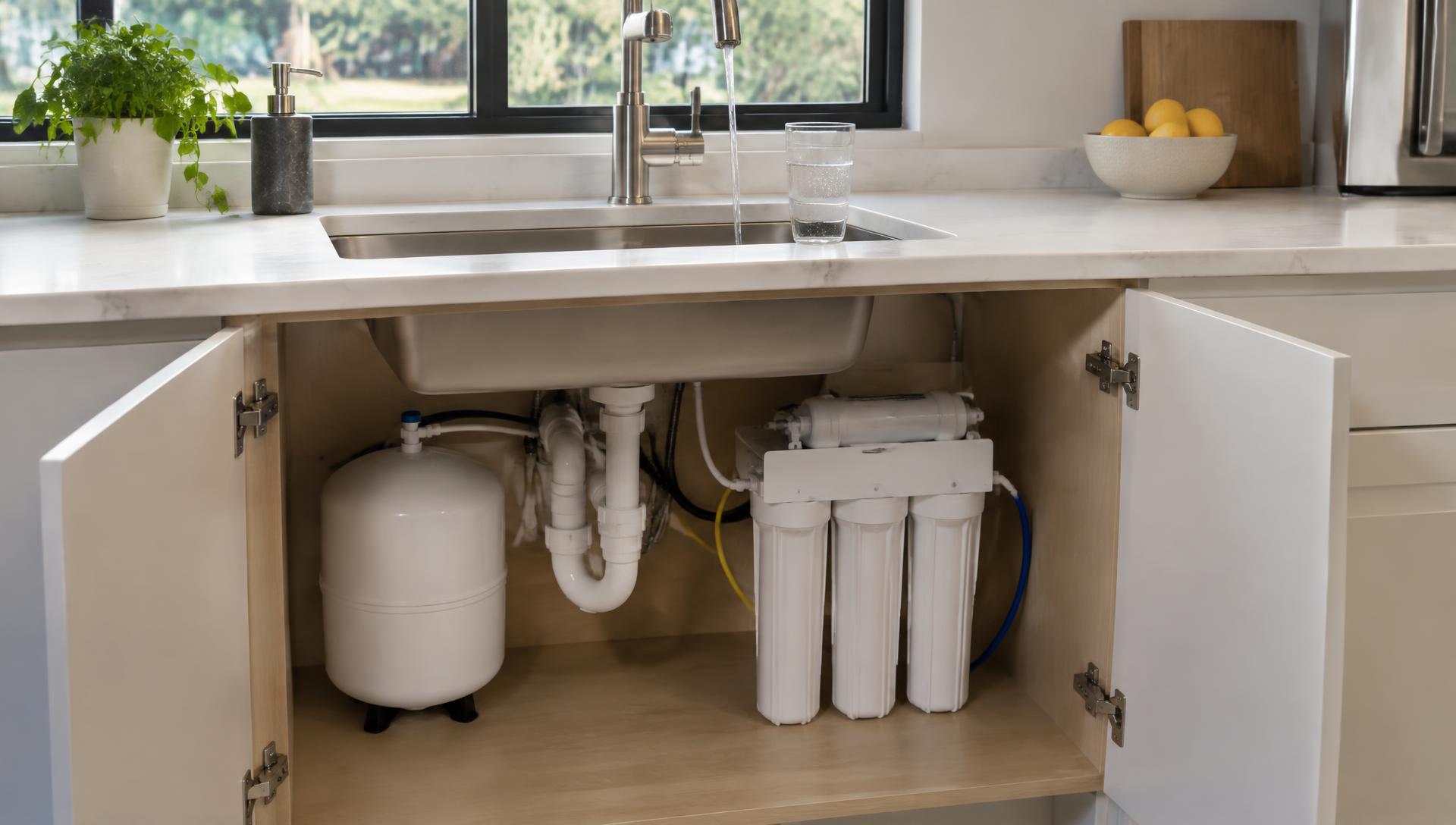
Reverse osmosis works by pressure and physics rather than adsorption. Water is pushed against a semipermeable membrane whose pores are so fine, a fraction of a thousandth the width of a human hair, that water molecules pass through while dissolved solids are rejected and flushed away. A typical under-sink RO system wraps that membrane in a sequence: a sediment pre-filter catches particles, a carbon stage removes chlorine that would damage the membrane, the membrane itself does the heavy lifting, and a final carbon polish refines the taste on the way to the faucet.
The result is the most thorough point-of-use purification available for a home. RO removes the broad range of dissolved solids carbon cannot touch: hardness minerals, sodium, lead, nitrate, fluoride, arsenic, and many others, typically reducing total dissolved solids by the large majority. That thoroughness comes with trade-offs. RO is slower, so systems store purified water in a small tank or, in tankless designs like our HW800, produce it on demand. RO sends some water down the drain to carry away the rejected solids. And RO costs more upfront than a carbon cartridge. What you get in return is drinking water refined to a level no carbon filter approaches.
Side by Side: What Each One Removes
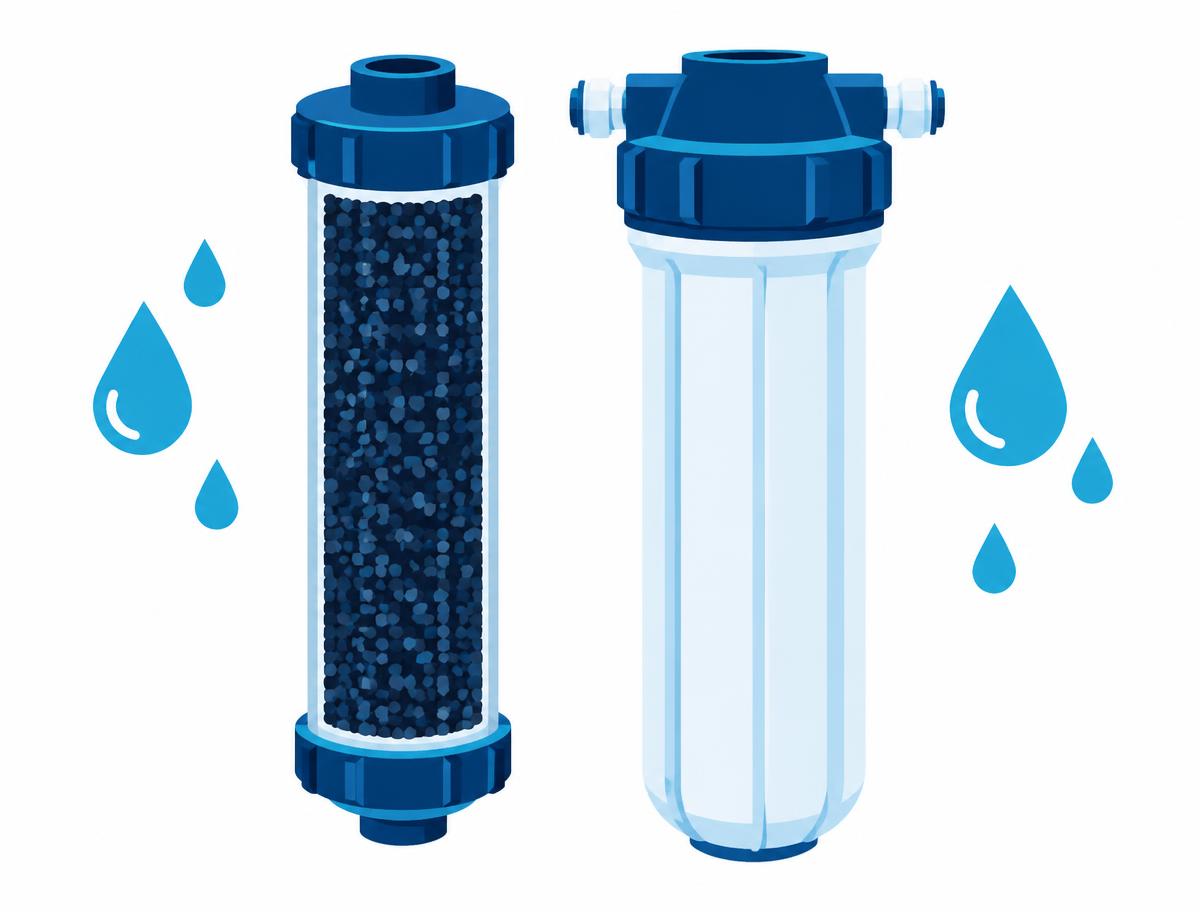
The cleanest way to compare is by contaminant category. Chlorine, taste, and odor: both handle these well, with carbon as the specialist. Dissolved minerals and hardness: only RO. Sodium, lead, nitrate, fluoride, and arsenic: only RO. Sediment and particles: both, when a sediment stage is included. Speed and flow: carbon wins easily, since RO works slowly by design. Water efficiency: carbon wastes nothing, while RO sends a reject stream to the drain. Upfront cost: carbon is far cheaper. Depth of purification: RO is in a different league.
Local data makes this comparison concrete. EWG, the Environmental Working Group, compiles utility testing from the Minnesota Department of Health. Its Minneapolis listing (data from 2015 to 2024) reports 19 contaminants detected, 10 above EWG health guidelines, and its Saint Paul Regional Water Services listing (2013 to 2024) reports 25 detected, 13 above EWG guidelines, including several PFAS compounds. Most items on both lists are disinfection byproducts, which certified carbon can reduce. Nitrate, hexavalent chromium, and PFAS are where reverse osmosis typically has the edge. Both utilities were in compliance with federal standards for the most recent quarter EWG reports, and EWG guidelines are stricter than legal limits. We reviewed both listings on October 22, 2026, and summarize them on our water quality page.
One more category matters to some households: what each leaves behind. Carbon leaves the water's natural minerals intact, which some people prefer for taste. RO removes nearly everything, producing very pure water with a clean, neutral taste; systems like ours can include a remineralization stage for those who prefer a hint of mineral character. Neither is objectively better. It is a preference, and knowing it is a preference keeps the decision honest.
Cost and Maintenance, Honestly
Carbon filtration is the budget option at the point of use: pitcher and faucet filters cost little, and under-sink carbon systems are modest. Whole-home carbon tanks cost more but treat every tap. Reverse osmosis costs more at the point of use: our tank RO systems are $799 installed and our HW800 tankless RO is $999, with published prices you can check before anyone visits. Notably, every whole-home package we install, starting at $2,999, includes a kitchen RO system at no additional cost, because we believe drinking water deserves the final level of refinement.
Maintenance differs in kind more than in burden. Carbon cartridges need replacement on a schedule measured in months, and whole-home carbon media lasts years. RO systems need their pre-filters and post-filter changed periodically and the membrane replaced on a multi-year schedule. Both are simple routines, and both should be explained clearly during your installation walkthrough, which is part of every install we do. The savings side is worth a mention too: families that switch from bottled water to RO often recover the system's cost surprisingly fast, and our savings calculator can estimate your household's numbers.
Tank vs. Tankless Reverse Osmosis
If you land on reverse osmosis, one more choice appears: tank or tankless. Traditional RO systems store purified water in a small pressurized tank under the sink, because the membrane produces water slowly. The tank means water is always ready at full flow, but it takes up cabinet space and adds a component to maintain. Tankless systems like our HW800 use higher-capacity membranes and pumps to produce purified water on demand, with no storage tank, a smaller footprint, and better water efficiency. The trade-offs are price and simplicity: tank systems cost less ($799 installed versus $999 for the HW800) and have decades of proven reliability, while tankless systems save space and waste less water. Both deliver the same purified water at the faucet.
What About Refrigerator Filters and Pitchers
Many households already own a carbon filter without thinking of it that way: the cartridge in the refrigerator door and the pitcher on the counter are both activated carbon. They work, within their limits. The limits are capacity and scope. A refrigerator cartridge treats only the dispenser and ice maker, and a pitcher treats only what you pour into it, slowly. Both need replacement on schedule to keep working, and an exhausted cartridge is decoration. If your family is diligent about replacements and only cares about cold drinking water, these can be enough. If you find yourself buying bottled water anyway, or wishing the cooking water and the kettle were covered too, a dedicated under-sink system ends the juggling.
Reading Certifications Without a Chemistry Degree
One last tool for comparing products: independent certification. Look for NSF/ANSI standards on any drinking-water product you consider. Standard 42 covers aesthetic effects like chlorine, taste, and odor. Standard 53 covers health-related contaminant reduction like lead. Standard 58 applies to reverse osmosis systems specifically. A product certified to a standard has been independently tested to do what it claims for that category, which is a far better signal than marketing language. When we recommend equipment, certification is part of the conversation, and it should be part of any company's.
The Bottled Water Math
For many families, the real comparison is not carbon versus RO. It is either of them versus the bottled water habit. A household buying cases of bottled water every week spends a steady, repeating amount that never ends and never builds anything: no equipment, no convenience at the tap, just recycling bins and grocery trips. An under-sink RO system produces water of comparable or better purity at the kitchen sink for a modest upfront cost and small filter changes, and it ends the hauling, the storage, and the plastic. Our savings calculator lets you run your own household's numbers, and for regular bottled-water buyers the payback period is often shorter than expected.
Ice, Coffee, and Cooking: Where You Notice It First
Purified water announces itself in the small things. Ice made from RO water freezes clearer and melts without adding taste to the drink. Coffee and tea taste cleaner because water is most of what is in the cup. Pasta, rice, and soups absorb the water they cook in, for better or worse. Humidifiers and steam irons run longer without mineral dust when fed purified water. None of these alone justifies a system, but together they describe what changes: every place water touches food, drink, or air in your home gets a quiet upgrade, and the kitchen faucet becomes the best water source in the house instead of an afterthought.
Which One Fits Your Home
For city water in the Twin Cities, the honest answer starts with what bothers you. If the issue is chlorine taste and odor alone, carbon solves it well and cheaply. If you want the most refined drinking water, if someone in the household prefers the lowest possible dissolved solids, or if you simply want to stop thinking about what is in the glass, RO is the right tool. Many homes land on both: whole-home carbon and softening for every tap, with RO at the kitchen sink for drinking and cooking. That is exactly the combination our whole-home packages are built around.
For well water, the calculus shifts toward RO. Wells can carry dissolved solids, nitrate, and other contaminants that carbon does not address, which is why every whole-home well package we install includes RO at the kitchen tap. As always with wells, a current accredited lab test comes first, as covered in our well water guide. And for any home, the decision should start with your water: city homes can check their utility's annual report, linked from our water quality page, and our Find Your Solution tool narrows the options in about two minutes.
A final note on getting the answer for your specific kitchen: the decision gets much easier with your water report in hand. City homes can pull their utility's annual report in minutes, and well homes should have a current accredited lab test before choosing anything. The report tells you whether chlorine taste is the whole story or whether dissolved solids, nitrate, or sodium belong in the decision too. With that one document, the right choice usually becomes obvious, and the wrong purchases become easy to avoid. If you would like a straight answer for your kitchen, a free phone consultation starts with your water source and your goals, not a product pitch. We serve Minneapolis, St. Paul, and surrounding communities across the metro. Carbon and RO are both excellent tools. The only wrong choice is the one made without knowing which job you needed done. So start with the water, name the job, and let the technology follow. If the answer turns out to be a simple carbon cartridge, we will say so. If it is a full RO system with a remineralization stage, we will explain why. Either way, you will know exactly what is under your sink, what it removes, and why it earned its place there. And if your household is still buying bottled water while you decide, run those numbers through the savings calculator on our pricing page. For most families, the clearest glass of water in the house has been waiting at the kitchen sink all along. It just needed the right filter between the supply line and the faucet.
Sources and further reading
Reviewed October 22, 2026. Utility reports describe the public supply, not an individual household sample. Check the utility for current reports and notices. Images are illustrative, not photographs of a customer installation.
Frequently asked questions
Is reverse osmosis better than a carbon filter?
They do different jobs. Carbon is the better tool for chlorine, taste, and odor, and it is faster and cheaper. Reverse osmosis removes a far broader range of dissolved solids, including minerals, sodium, lead, nitrate, and fluoride, that carbon cannot touch. For better-tasting city water, carbon often suffices. For the most refined drinking water, RO is the stronger choice, and many homes use both.
Does a carbon filter remove lead?
Standard carbon cartridges are not reliable for lead removal. Some specialized carbon blocks are certified for lead, but reverse osmosis is the proven point-of-use technology for lead and a broad range of dissolved contaminants. If lead is a concern, an accredited lab test tells you your level, and RO addresses it at the kitchen tap.
Does reverse osmosis waste water?
RO systems send a reject stream to the drain to carry away the dissolved solids the membrane removes. Traditional tank systems use a few gallons of reject water per gallon purified; modern tankless designs like our HW800 are considerably more efficient. Because RO treats only drinking and cooking water at one tap, the total volume involved is small for most households.
Does reverse osmosis remove healthy minerals?
Yes, RO removes dissolved minerals along with contaminants, producing very pure water with a clean, neutral taste. The minerals in drinking water are a minor source compared to food, but for those who prefer mineral character, systems can include a remineralization stage. It is a preference, not a health requirement.
What does a reverse osmosis system cost in the Twin Cities?
With Minnesota Water Pros, tank reverse osmosis systems are $799 installed and the HW800 tankless RO is $999. Every whole-home package, starting at $2,999 installed, includes a kitchen RO system at no additional cost. All prices are published on our pricing page, and every system carries a lifetime warranty.
Can I use both carbon and reverse osmosis together?
Yes, and many Twin Cities homes do. Whole-home carbon filtration removes chlorine at every tap, which also protects the softener's resin and the RO membrane. The RO system then provides the final refinement for drinking and cooking water at the kitchen sink. The technologies complement each other rather than compete.
More from the blog
Does a City-Softened Minneapolis Home Need Extra Water Treatment?
Minneapolis already softens its municipal water. Here is how to decide whether additional household treatment serves a real purpose.
Saint Paul Drinking-Water Taste: Kitchen Filter or Main-Line Treatment?
A kitchen taste preference and a whole-home treatment goal are different projects. Learn how to compare them in an existing Saint Paul home.
Bloomington Water Treatment for Houses and Condos: Know Your Plumbing
Bloomington's combined municipal supply is only part of the decision. Your plumbing boundary and maintenance authority determine which options fit.
Edina or Morningside? Plan the Right Water Treatment for Your Remodel
Edina's two water systems make address-level planning important. Learn how to connect your supply, household measurements, and kitchen remodel decisions without assuming every home needs the same equipment.
Talk through your water with a local pro
A free phone consultation starts with your water source and your goals. Published installed pricing, kitchen reverse osmosis included with every whole-home package, and a best-price guarantee.