
Minnesota Water Pros blog
How Does a Water Softener Work? Ion Exchange, Explained Simply
Published October 1, 2026 · 10 min read · Educational content only, not a water quality diagnosis.
In this guide
- What hard water actually is, and why calcium and magnesium cause scale, spots, and soap scum.
- How ion exchange works inside the mineral tank, step by step.
- What the brine tank does and how the regeneration cycle recharges the system.
- What a softener does not do, and why it is not a filter.
- How salt-free conditioners differ, and when each approach makes sense.
A water softener sits quietly in your basement or utility room, asks for a bag of salt now and then, and otherwise draws no attention to itself. Yet it is running a clever bit of chemistry every time you open a tap. Understanding how it works takes about ten minutes, and it pays off: you will know what the system can and cannot do, why it needs salt, and how to spot the difference between a softener and the other treatment equipment it is often confused with.
This guide explains the whole process in plain language: what hard water is, what happens inside the tank, what the regeneration cycle does, and where softening fits among the other treatment options like whole-home filtration and reverse osmosis. No chemistry degree required.
First, What Makes Water Hard
Hardness is not a contaminant in the dangerous sense. It is simply dissolved calcium and magnesium, picked up as water moves through soil and rock on its way to your tap. Minnesota's geology makes hard water common across the state, which is why the Minnesota Department of Health publishes guidance specifically about home water softening. Hardness is measured in grains per gallon, and the higher the number, the more mineral your water carries.
Those minerals are harmless to drink. The trouble is what they do when water is heated or evaporates. Calcium and magnesium come out of solution and form a hard, chalky deposit called scale. Scale is the white crust on your faucets, the spots on your glassware, the film on your shower door, and, invisibly, the coating inside your water heater and pipes. Hardness minerals also react with soap to form a sticky curd, which is why hard water lathers poorly and leaves residue on skin, hair, and laundry. If any of that sounds familiar, our guide to the signs of hard water walks through what to look for.
The Heart of the System: Resin Beads
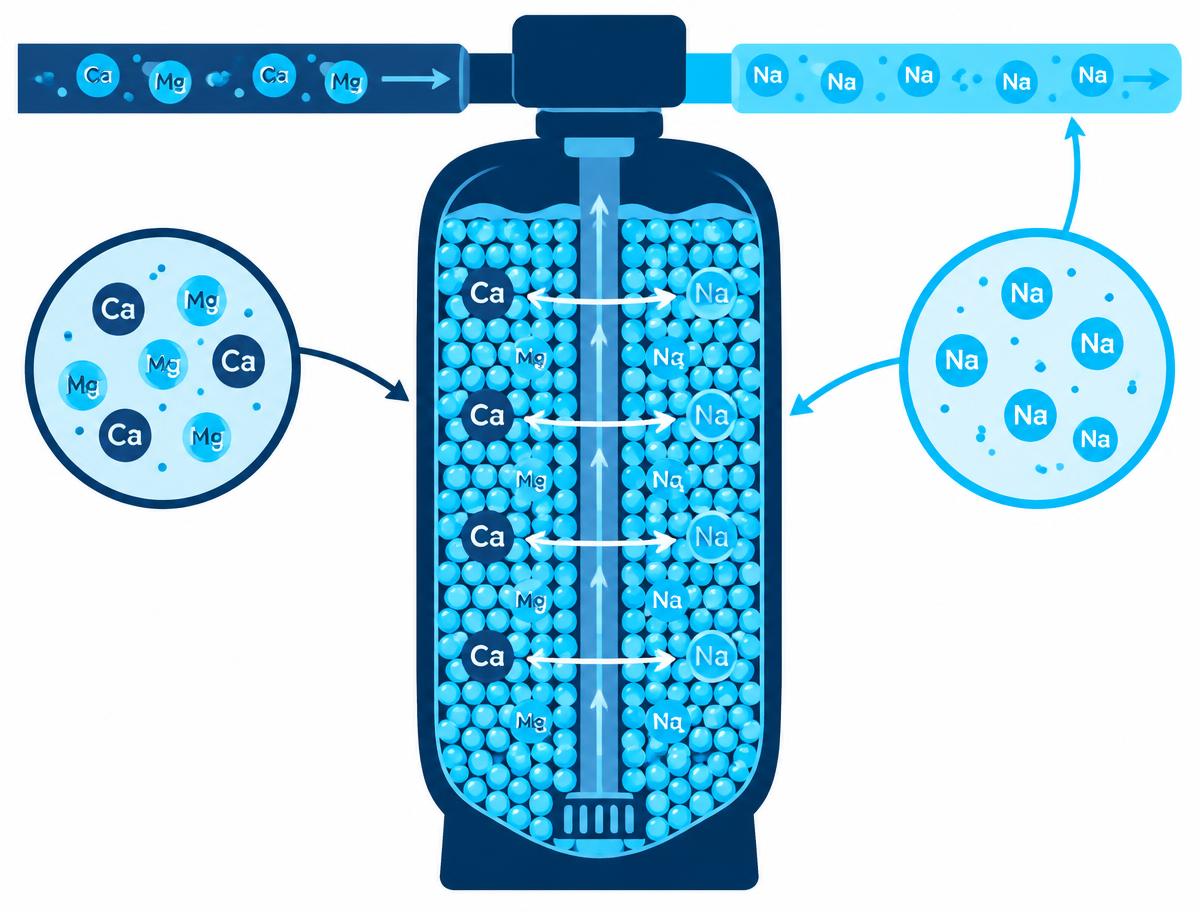
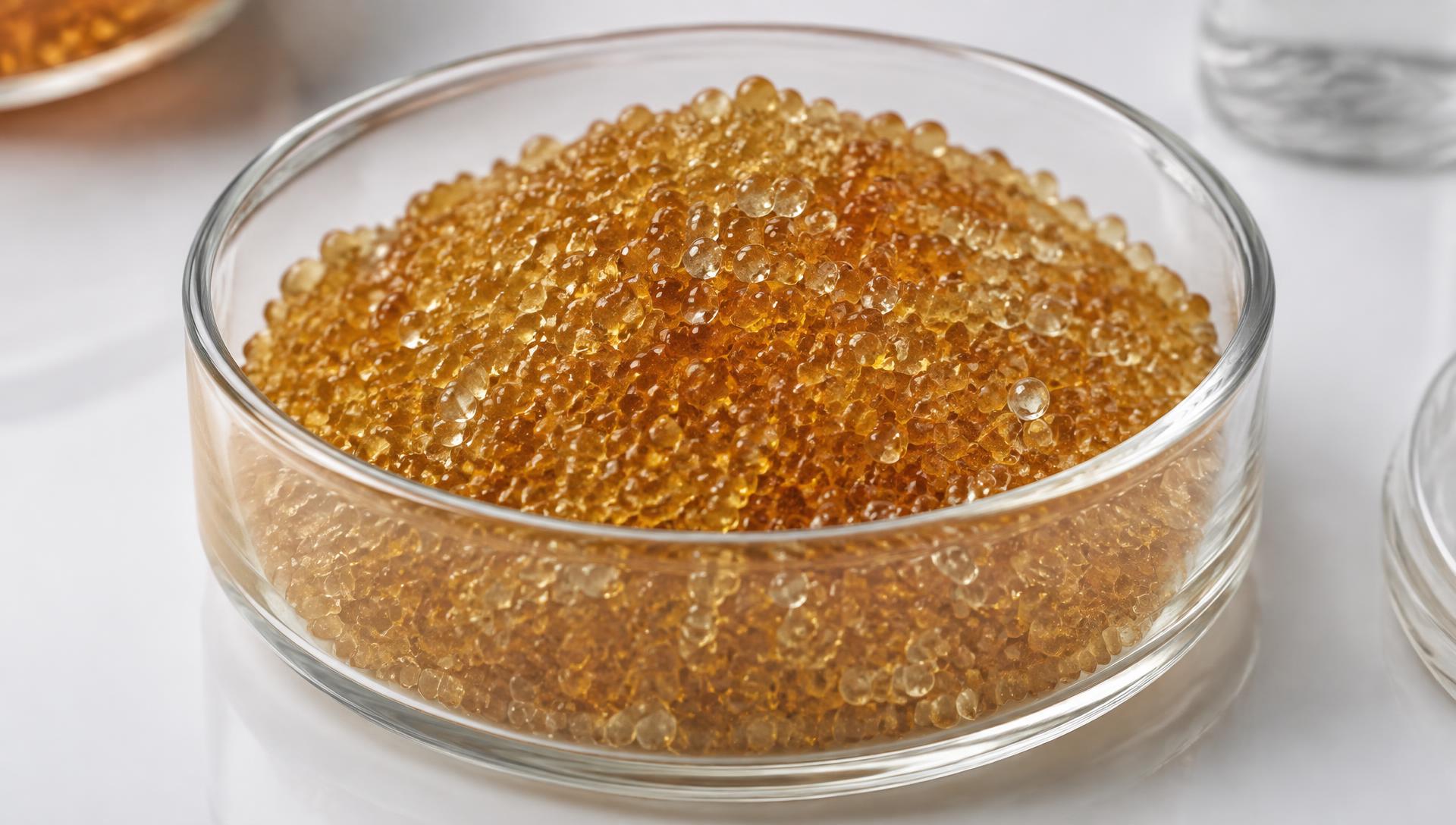
Inside the tall tank of a softener, called the mineral tank, are thousands of tiny plastic spheres called resin beads. Each bead carries a negative electrical charge, and each one comes pre-loaded with sodium ions, which carry a positive charge and cling to the beads. This setup is the entire trick, because of one chemical fact: calcium and magnesium ions carry a stronger positive charge than sodium ions do.
When hard water flows through the tank, the calcium and magnesium in the water are attracted to the beads more strongly than the sodium is. The beads grab the hardness minerals and let go of the sodium, which flows out with the water. This swap is called ion exchange, and it happens continuously as water passes through. What comes out of the tank is softened water: the hardness minerals are stuck to the beads, and a small amount of sodium has taken their place.
Two things are worth noting about that sodium. First, the amount is small and proportional to how hard your water is, since the exchange is one-for-one by charge. Second, the Minnesota Department of Health notes that people on sodium-restricted diets may want to discuss softened water with their physician, and that an unsoftened tap or a reverse osmosis system at the kitchen sink are practical alternatives for drinking water. Reverse osmosis actually removes sodium along with most other dissolved solids, which is one reason the two systems pair so well.
The Regeneration Cycle: How the System Recharges
Resin beads have a finite capacity. After treating a certain amount of water, the beads are coated with calcium and magnesium and cannot capture any more. That is where the second tank, the brine tank, comes in. The brine tank holds salt, either as pellets or crystals, dissolved in water to make a concentrated salt solution called brine.
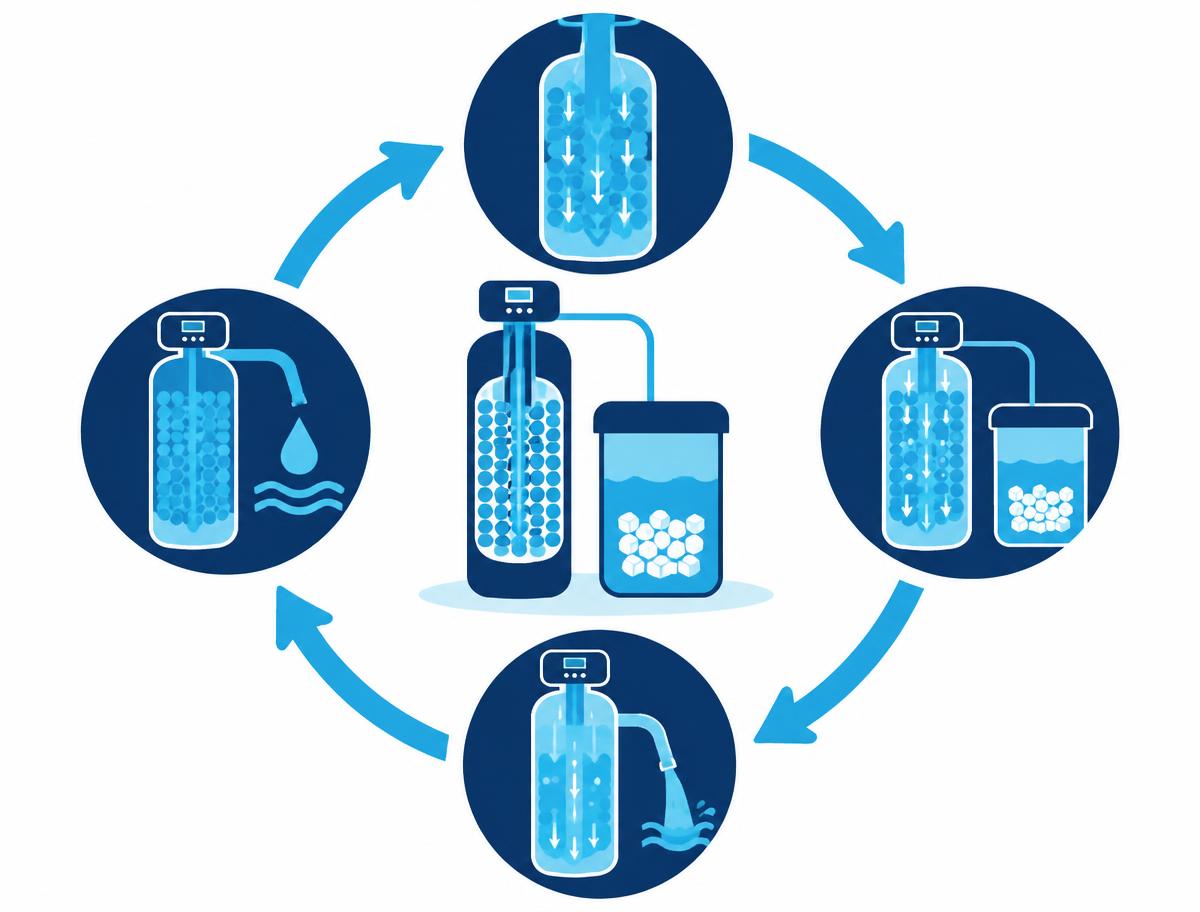
During regeneration, the system runs a sequence of cycles. It draws brine from the brine tank and washes it through the mineral tank. The brine is so concentrated with sodium that it overwhelms the beads' grip on the hardness minerals: the calcium and magnesium are knocked loose, the beads are re-coated with sodium, and the mineral-laden brine is flushed down the drain. A rinse cycle clears any remaining brine, and the system returns to service, recharged and ready. The whole process typically happens in the early morning hours when water use is low, and a properly sized system regenerates every few days rather than every night.
Modern systems decide when to regenerate in one of two ways. Timer-based units regenerate on a fixed schedule. Metered units, also called demand-initiated regeneration, track your actual water use and regenerate only when the resin is nearly exhausted. Metered regeneration uses less salt and less water, and it is the style we recommend for most households. If you are comparing equipment, our guide to choosing the best water softener covers regeneration styles, capacity, and certifications in detail.
What a Softener Does Not Do
This is the most misunderstood part of water treatment, so it deserves its own section: a water softener is not a filter. Ion exchange removes hardness minerals. It does not remove chlorine, disinfection byproducts, lead, PFAS, sediment, or bacteria. If your concern is the taste or smell of chlorine, or the contaminants that show up in utility testing, softening alone will not address them. Our local water quality page shows what Minneapolis and St. Paul testing actually detects, with sources and reporting periods, if you want to see what else is in the conversation.
That is why many homes use more than one treatment stage. A typical setup pairs a softener with carbon filtration: the softener handles hardness, and the carbon addresses chlorine taste and odor along with a range of chemical compounds. Drinking water often gets a third stage, reverse osmosis, which pushes water through a membrane fine enough to reduce most dissolved solids. Each piece does the job it was designed for. You can compare the systems side by side to see how the categories fit together.
Where Salt-Free Conditioners Fit
Salt-free systems work on a different principle entirely. Instead of removing hardness minerals, they use a process that changes how the minerals crystallize, so scale is less likely to stick to pipes and heating elements. The calcium and magnesium stay in the water. That means no salt bags, no brine discharge, and no regeneration cycle, but also no true soft water: spots and soap behavior will not change the way they do with ion exchange. For some households that trade-off is perfect, and for others it is a dealbreaker. Neither approach is universally right, which is why we offer both in our product catalog.
Why Sizing and Setup Matter as Much as the Chemistry
Ion exchange is reliable chemistry, but the equipment around it has to be matched to your home. A system with too little capacity regenerates constantly and wears out early. One configured for the wrong hardness level wastes salt or lets hard water slip through. Flow rate matters too: an undersized valve restricts pressure exactly when your household needs water most. Professional sizing accounts for your hardness level, household size, plumbing, and usage patterns, and professional installation makes sure the system is programmed for your actual water, not a factory default.
The Parts of the System, and What Each One Does
A softener looks like two tanks and a box of electronics, and that is exactly what it is. The tall mineral tank holds the resin beads where ion exchange happens. The shorter brine tank holds the salt that makes regeneration possible; you refill it every month or two, and keeping the salt level above the water line is the one chore the system asks of you. On top of the mineral tank sits the control valve, the brain of the operation. It meters your water use, decides when to regenerate, and runs the cycle sequence automatically.
A few smaller parts matter too. The bypass valve lets you route water around the softener, which is useful for watering the garden or servicing the system without shutting off water to the house. The drain line carries the mineral-laden brine away during regeneration. And the control valve's programming, your hardness level, your household size, your regeneration preferences, is what turns generic hardware into a system tuned to your water. That programming is part of professional installation, and it is why two identical tanks can perform very differently in different homes.
Maintenance is genuinely light. Keep salt in the brine tank, break up any salt bridges that form (a crust of hardened salt that hides an empty tank), and have the system checked periodically. The resin itself lasts for years under normal conditions, though high chlorine or iron levels can shorten its life, which is one more reason city-water homes often pair softening with carbon filtration and well homes treat iron upstream. When filters or media eventually need replacement, having a local company that services what it installs makes the difference between a quick visit and a scavenger hunt.
Softened Water and Your Home's Plumbing
One question homeowners ask is whether softened water is corrosive. It is not. Softening swaps calcium and magnesium for sodium; it does not make water acidic, and the sodium added is modest, roughly proportional to the hardness removed. What softened water does do is stop new scale from forming and gradually dissolve existing scale inside pipes and appliances, which is why some homes notice their aerators shedding small flakes for a few weeks after installation. That is the old buildup leaving, and it passes.
Homeowners on low-sodium diets sometimes ask about drinking softened water. The sodium contribution is small compared to dietary sources, but it is real, and the standard answer is simple: drink from a reverse osmosis tap. Reverse osmosis removes sodium along with the broad range of dissolved solids it addresses, which is one reason every whole-home package we install includes an RO system at the kitchen sink. You get the whole-home benefits of soft water and the drinking-water refinement of RO, and the question resolves itself.
Frequently Confused: Softeners, Filters, and Conditioners
The water treatment aisle is full of overlapping names, so a quick disambiguation helps. A softener removes hardness minerals through ion exchange, full stop. A filter, typically carbon, removes chlorine, tastes, and odors but does not soften. A salt-free conditioner changes how minerals crystallize so they stick less to surfaces, but the minerals stay in the water, so it is not softening and the water still tests hard. Reverse osmosis is a drinking-water technology that removes a broad range of dissolved solids at a single tap. Each tool has a real job, and none of them does the others' jobs. When a product claims to do everything in one small cartridge, you now know enough to be skeptical.
This is also why combination systems exist. A city-water home that wants soft water and better taste needs both softening and carbon filtration, which is exactly what our whole-home packages pair together, with reverse osmosis at the kitchen sink included at no additional cost. Understanding the chemistry means you can look at any package, ours or anyone's, and know precisely which job each tank is doing.
If you are curious what softening would look like for your home, a free phone consultation starts with your water source and your goals, and our published installed prices mean you can see the cost before anyone visits. We serve Minneapolis, St. Paul, and surrounding communities across the metro. The chemistry is simple, the equipment is proven, and the results show up in the first week: in the shower, in the dishwasher, and in every glass that dries clear. Getting the system matched to your home is where experience earns its keep, and now you know exactly what that matching involves.
Frequently asked questions
How does a water softener remove hardness?
Through ion exchange. Hard water flows through a tank of resin beads that hold sodium ions. The calcium and magnesium that cause hardness carry a stronger charge, so the beads capture them and release sodium in their place. The result is softened water, with the hardness minerals held on the resin.
Why does a water softener need salt?
Salt recharges the resin. When the beads fill up with hardness minerals, the system flushes them with brine from the salt tank. The concentrated sodium knocks the calcium and magnesium loose, they flush down the drain, and the beads are re-coated with sodium and ready to soften again.
Does a water softener filter out contaminants?
No. A softener removes hardness minerals only. It does not remove chlorine, disinfection byproducts, lead, PFAS, or sediment. Homes that want broader treatment typically pair a softener with carbon filtration for the whole house and reverse osmosis for drinking water.
Is softened water safe to drink?
Softening adds a small amount of sodium proportional to your hardness level. The Minnesota Department of Health notes that people on sodium-restricted diets may want to discuss softened water with their physician. A reverse osmosis system at the kitchen tap removes sodium along with most dissolved solids, which is why the two pair well.
How often does a water softener regenerate?
It depends on your hardness, water use, and system capacity. A properly sized system typically regenerates every few days, usually in the early morning hours. Metered systems track actual water use and regenerate only when needed, which uses less salt and water than timer-based schedules.
What is the difference between a softener and a salt-free conditioner?
A softener removes hardness minerals through ion exchange, producing genuinely soft water. A salt-free conditioner changes how minerals crystallize so scale sticks less, but the minerals remain in the water. Conditioners need no salt and no regeneration, but they do not deliver the spot-free, easy-lather results of true softening.
More from the blog
Does a City-Softened Minneapolis Home Need Extra Water Treatment?
Minneapolis already softens its municipal water. Here is how to decide whether additional household treatment serves a real purpose.
Saint Paul Drinking-Water Taste: Kitchen Filter or Main-Line Treatment?
A kitchen taste preference and a whole-home treatment goal are different projects. Learn how to compare them in an existing Saint Paul home.
Bloomington Water Treatment for Houses and Condos: Know Your Plumbing
Bloomington's combined municipal supply is only part of the decision. Your plumbing boundary and maintenance authority determine which options fit.
Edina or Morningside? Plan the Right Water Treatment for Your Remodel
Edina's two water systems make address-level planning important. Learn how to connect your supply, household measurements, and kitchen remodel decisions without assuming every home needs the same equipment.
Talk through your water with a local pro
A free phone consultation starts with your water source and your goals. Published installed pricing, kitchen reverse osmosis included with every whole-home package, and a best-price guarantee.