
Minnesota Water Pros blog
Bloomington, Minnesota · Local service informationBloomington Water Treatment for Houses and Condos: Know Your Plumbing
Published October 22, 2026 · 14 min read · Educational content only, not a water quality diagnosis.

In this guide
- Combined municipal supply calls for Bloomington-specific information rather than borrowed assumptions.
- Property ownership and plumbing boundaries determine which treatment options are actually available.
- Building-level flow differs from one household's demand and must be evaluated accordingly.
- Kitchen treatment can be compared separately from central softening or filtration.
- Maintenance responsibility, documented performance, installation authority, and total cost need written clarity.
What EWG's Tap Water Database Shows for Bloomington
The Environmental Working Group (EWG) compiles utility testing results supplied by the Minnesota Department of Health. Its listing for the Bloomington water system, which EWG shows serving about 89,987 people from purchased surface water with data from 2014 to 2023, reports 20 contaminants detected, 10 of them at levels above EWG's health guidelines. The largest gaps EWG lists are Haloacetic acids (HAA9) (about 211 times the guideline), Haloacetic acids (HAA5) (about 130 times the guideline), and Total trihalomethanes (TTHMs) (about 91 times the guideline). Several of the listed items are disinfection byproducts, which form when the chlorine that keeps water safe in the pipes reacts with natural organic matter. We reviewed this listing on October 22, 2026, and you can read the full breakdown on [EWG's Bloomington page](https://www.ewg.org/tapwater/system.php?pws=MN1270001).
Context matters. EWG's guidelines are its own health benchmarks and are often far stricter than federal legal limits, and many of the listed substances have no legal limit at all. For the most recent quarter EWG reports from the U.S. EPA (April to June 2024), this system was in compliance with federal health-based drinking water standards. Utility data describes the public supply, not the water at your tap, so it is a starting point for a conversation rather than a verdict on your home. If any listed item matters to your household, match it to equipment certified to reduce that specific substance, and compare the Minneapolis and St. Paul snapshots on our water quality page.
Begin with Bloomington, not a neighboring city's shortcut
Bloomington's official utilities resources describe two sources supplying its distribution system: the city's water treatment plant and a connection to the Minneapolis distribution system. That is the useful starting fact. It does not establish a fixed blend at every faucet, a particular current hardness at your address, or a need for any household equipment. Do not copy a Minneapolis treatment recommendation into a Bloomington proposal merely because the systems are connected. Likewise, do not infer that the city's own plant makes its water equivalent to untreated groundwater. Use Bloomington's own current reports and ask the utility for clarification when a source or treatment question matters to the decision.
The reports-and-resources page includes planning material as well as water-quality information, so pay attention to dates and purpose. A master-plan description helps explain infrastructure but is not a household sample or a promise about today's operating proportions. An annual quality report summarizes monitoring over its stated period rather than measuring every apartment faucet. Keep those distinctions visible when gathering information. The Bloomington service-area overview can organize local planning questions, while the city's current notices remain the authority for public-supply instructions. A careful guide should help you ask better questions without inventing a neighborhood-by-neighborhood water map that the utility has not supplied.
Find the boundary you actually control
In a detached home, an owner may control an accessible incoming line and have room for treatment in a utility area. In a condominium or apartment, the apparent water line in a cabinet may be only a fixture branch, while the incoming main and central equipment belong to the building. A townhouse can have either arrangement or something more complicated. The property label alone does not identify the plumbing. Ask for available drawings, locate shutoffs with permission, and determine whether a proposed connection serves only your dwelling. Do not install a main-line device based on an assumption that every pipe behind your wall belongs exclusively to you.
Ownership and physical access are separate issues. A pipe may be visible but still be part of common property, and a unit owner may have maintenance obligations without authority to alter the central system. Renters should seek owner approval before permanent connections, and condominium owners should review association requirements. Ask who may authorize plumbing changes, who schedules any shutdown, and who is responsible if a leak affects another unit. These are not merely administrative details. They determine whether a kitchen-level device, a unit-branch installation, or a coordinated building project is feasible. A contractor should confirm the relevant boundaries rather than treating an individual resident's preference as permission to modify shared infrastructure.
Create two checklists: water goals and plumbing authority
On the water-goals checklist, separate hardness-related scale, drinking-water taste, visible sediment, and any named health-related concern. Record which fixtures are involved and whether existing central or individual treatment already affects them. On the authority checklist, identify the property owner, association or manager, permitted work area, required approvals, and maintenance decision-maker. Combining these lists prevents a common mistake: selecting a technically appealing tank before discovering that the resident cannot connect it to the relevant line. It also keeps a focused drinking-water preference from expanding into a buildingwide project that other residents have not requested or approved.
Use evidence appropriate to each water question. For hardness, obtain a suitable kit result or laboratory measurement and record the units and sample location. For a specific contaminant, review official guidance and use a suitable accredited laboratory when household testing is warranted. For a routine taste preference, compare cold-water samples consistently only when there is no advisory or suspected incident. A dissolved-solids meter is not a substitute for all these tasks. Neither clear water nor a pleasant taste establishes safety, and a spot on a shower door does not identify a dangerous substance. Unexpected discoloration or a new unusual odor deserves utility or building-management attention rather than an automatic filter purchase.
- Water goals: name the concern, identify affected fixtures, record measurements, and document existing treatment.
- Plumbing authority: confirm ownership, approval requirements, exclusive or shared branches, and who may operate shutoffs.
- Long-term responsibility: identify who will replace consumables, arrange service, keep records, and respond to a leak.
Compare the no-additional-treatment option fairly
No added equipment should remain a legitimate option when municipal water and existing building systems meet the household's needs. Review any central treatment before buying a second device inside a unit. Ask what the building already operates, which branches it serves, and whether service records are available. If the supply is centrally softened, a unit-level hardness test should be interpreted in that context. Buying another softener simply because a regional advertisement mentions hard water can duplicate treatment without solving a real problem. The hard-water-versus-soft-water guide explains the concepts, but measurements and actual plumbing determine what reaches your fixtures.
A resident might instead need appliance maintenance, an overdue refrigerator cartridge, or clarification of a building notice. A glass with residue does not prove central equipment has failed, and a different taste after moving does not prove the new supply is unsafe. Discuss sudden buildingwide changes with management and the utility before treating them as individual purchasing decisions. Shared observations can help identify whether a concern occurs in one unit, one riser, or throughout the property. That investigation should respect privacy and access rules. It is not a reason for residents to operate shared valves, change central settings, or sample restricted mechanical rooms without authorization.
Compare softening for measured hardness
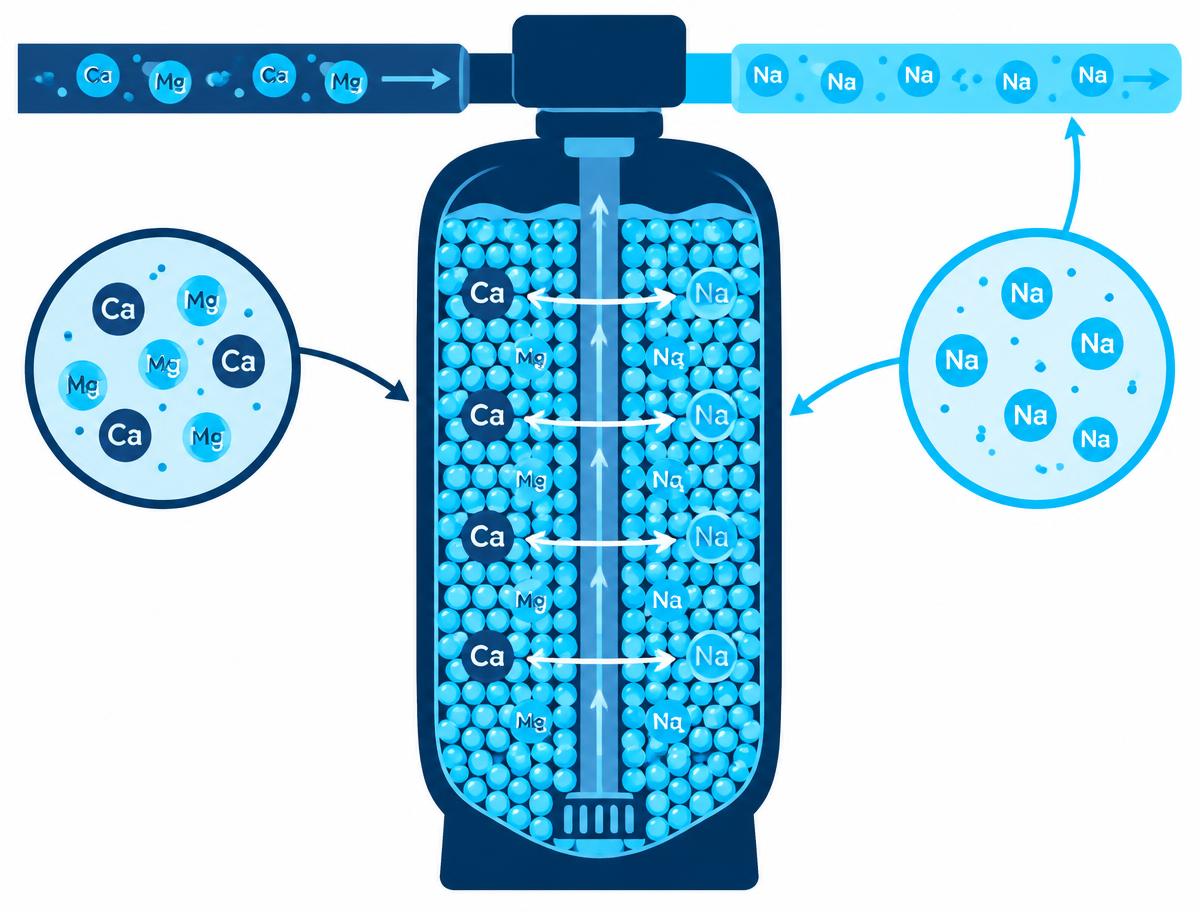
A conventional softener uses ion exchange to reduce calcium and magnesium associated with hardness. It is most relevant when measured hardness and the household's scale or appliance goals justify the tradeoffs. The Minnesota Department of Health says there is no requirement to soften water and describes it as a personal choice. Its discussion includes sodium addition, chloride impacts, maintenance, and potential plumbing considerations. None of that supports a blanket statement that every Bloomington home should install a softener. The guide to how a water softener works helps interpret regeneration and resin operation without making a recommendation for every address.
In an individually plumbed home, sizing should consider measured hardness, actual water use, peak demand, and the proposed treatment path. In a shared property, central softening must be evaluated for building demand and operational responsibility, not by multiplying a household brochure's tank recommendation by the number of units. Determine whether outdoor taps, irrigation, or selected drinking-water branches should remain outside treatment where practical and appropriate. Confirm drain capacity, power if needed, bypass access, salt-delivery access, and service clearance. A unit-level softener may be impractical where a resident lacks a suitable drain or exclusive incoming branch. That constraint should be stated plainly rather than hidden behind an attractive equipment description.
Compare carbon at the kitchen and at the building entry
Point-of-use carbon filtration can be considered when one household wants a documented taste-and-odor change at a kitchen tap. The installation boundary may be simpler than a central project, but permission, leak responsibility, replacement access, and appliance compatibility still matter. Verify the exact cartridge's reduction claims, rated flow, capacity, and fit for the utility's treatment chemistry. Carbon is a category, not a universal performance guarantee. A product that improves a taste does not automatically reduce every health-related substance, and a certification for one claim does not establish another. Explore the relevant product categories without assuming that a general description decides which model belongs in a particular unit.
Central carbon filtration is a different undertaking. It treats a larger volume, affects downstream plumbing conditions, and requires a maintenance plan that survives staff changes and resident turnover. Design should consider peak demand, contact time, pressure loss, media replacement, bypass operation, and the effects of reducing a disinfectant residual before water moves through shared piping. Ask who monitors performance and how residents will be informed during bypass or service events. A large tank does not by itself establish adequate treatment. If only one resident dislikes kitchen taste, a buildingwide installation may be disproportionate. If multiple locations share a documented goal, the building can evaluate central treatment through an authorized, properly designed process.
Compare RO for an individual drinking-water goal
RO commonly supplies a dedicated drinking-and-cooking faucet through a membrane-based system with supporting stages. It can be evaluated separately from buildingwide softening because it serves a much smaller water stream and different objectives. Suitability depends on the exact model's documented claims, source-water conditions, and the household's operating preferences. It does not automatically treat showers or laundry, and it produces reject water during normal operation. Read the reverse-osmosis-versus-carbon-filter guide before deciding that a membrane is necessary. A resident satisfied with a simpler documented taste-and-odor option may have no reason to choose additional complexity.
For a unit-level installation, measure cabinet space, identify the cold-water branch, and confirm an approved drain connection and faucet location. Check requirements for pressure, power where applicable, storage, recovery, and service access. Some buildings restrict countertop drilling or require particular plumbing contractors and leak-protection measures. A proposed refrigerator connection needs a verified tubing route and compatibility with the appliance's pressure requirements. Do not assume that a kitchen system is automatically portable, noninvasive, or permitted because it is small. Renters and owners should understand removal obligations and how the original plumbing will be restored if equipment is later taken out. Put those details in writing before installation rather than negotiating them after a move.

Demand documented reduction performance, especially for named substances
Ask for the exact model, replacement component identifiers, performance data sheet, and relevant certification listing. Read what was evaluated, at what flow and capacity, and under which operating conditions. A statement that a product is certified is incomplete without the applicable claim. If a building purchases equipment centrally, keep those documents where future managers and service providers can find them. Residents should not have to infer performance from a tank label or an old meeting summary. Maintenance schedules, rated capacities, and replacement records are part of the evidence that a system is being operated as intended, not optional paperwork after the purchase.
Do not imply automatic PFAS removal from a softener, a generic carbon filter, or an unspecified RO system. If PFAS or another named substance is a concern, consult current utility and health information and verify the exact relevant reduction claims for the proposed model. Appropriate laboratory testing may be useful for a defined household or building question, but sampling should follow a suitable plan and laboratory instructions. A taste comparison or dissolved-solids reading cannot establish PFAS performance. Household equipment does not replace municipal treatment, infrastructure work, or official emergency instructions. A documented reduction goal is a reason to evaluate a particular system, not permission to promise that all water-quality risks have disappeared.
Plan installation around neighbors as well as equipment
An individual-house installation generally concentrates decisions within one household. Shared plumbing adds coordination: notice periods, access to mechanical spaces, shutdown timing, drain routes, and the possibility that a mistake affects other dwellings. Confirm who can isolate the work area and restore service. The installer should review applicable permits, plumbing requirements, backflow protection, and any required air gaps rather than relying on a generic diagram. Where existing valves or piping need repair, separate that work from the treatment proposal. Treatment does not fix unreliable shutoffs, inaccessible piping, or a building's maintenance backlog, and those problems should not be hidden within an unexplained installation allowance.
Think beyond the day of installation. Can a technician remove a cartridge without taking out a cabinet? Can a central media vessel be serviced through the mechanical-room doorway? Is there safe access for salt delivery if softening is selected? Who receives leak alerts, and who can act when the resident or manager is away? Ask how bypass operation will be labeled and whether a temporary bypass changes any documented treatment goal. A serviceable design includes room, instructions, and responsibility. The smallest purchase price is not necessarily the best plan if maintaining the equipment requires repeated disruption to neighbors or access that nobody is authorized to provide.
Build a budget with clear responsibility
Use the pricing page for current published guidance, then request a written proposal matched to the actual property. For an individual system, include equipment, approved installation, plumbing modifications, optional refrigerator work, replacement parts, and service. For a shared system, also clarify design, access coordination, shutdowns, commissioning, ongoing monitoring, and responsibility for consumables and repairs. Avoid copying dollar amounts from another property because its plumbing boundaries and required work may be very different. No universal savings claim is justified without a meaningful baseline, actual water use, operating assumptions, and ongoing costs. A central purchase and an individual kitchen device are not comparable merely because both are called filtration.
For shared installations, decide how costs are authorized and allocated through the property's established process. The editorial goal is not to prescribe legal arrangements, but to flag questions that should be resolved before equipment is ordered. Who owns the system, pays for replacement media, approves emergency repairs, and keeps records when management changes? For unit systems, clarify responsibility for leaks, removal, and restoration under the applicable agreement. Review equipment only after these boundaries are understood. The contact page provides available contact information for a planning conversation, but a form should not be assumed to have delivered a request or confirmed a visit.
Use a practical maintenance routine
Keep a central record for shared equipment and a household record for individual devices. Save model numbers, manuals, replacement dates, service invoices, settings, startup measurements, and any relevant laboratory results. Follow manufacturer time and capacity limits rather than replacing media only when taste changes. Inspect accessible connections periodically and know how authorized shutoff procedures work. Investigate declining flow, leaks, unusual noise, or a sudden water change rather than assuming every symptom is a cartridge problem. When a building changes occupancy, equipment settings, or plumbing routes, revisit whether the existing design and maintenance schedule still match the water being treated.
Choose by supply, boundary, goal, evidence, and upkeep
A useful Bloomington comparison has five lines: what the utility says, what plumbing you control, what outcome you want, what the specific system documents, and who will maintain it. A detached-home owner with measured hardness concerns may evaluate a softener. A condominium resident focused on drinking-water taste may compare a permitted kitchen filter with RO. A building with a broader documented goal may commission a central design. Another household may add nothing. These are distinct decisions within one city, not stages every resident must complete. Keeping the combined municipal supply and the shared-versus-individual plumbing question visible makes the final choice more practical and less dependent on generic treatment advertising.
Sources and further reading
Reviewed October 22, 2026. Utility reports describe the public supply, not an individual household sample. Check the utility for current reports and notices. Images are illustrative, not photographs of a customer installation.
Frequently asked questions
Does the Minneapolis connection mean Bloomington needs the same treatment advice?
No. Bloomington describes its own plant and a connection to Minneapolis, so use Bloomington-specific reports and household measurements. That infrastructure fact does not establish a fixed blend, a particular hardness at your tap, or an automatic need for additional treatment. Avoid borrowing a neighbor city's recommendation without checking your own conditions.
Can I install a whole-home system in a condominium?
Only after confirming the plumbing boundary and obtaining required approvals. A unit may not have an exclusive accessible incoming line, and shared infrastructure may be controlled by the association or owner. A qualified installation assessment and the property's rules should determine feasibility before equipment is selected or plumbing is altered.
Is a kitchen filter useful if the building already treats water?
Possibly, if it addresses a separate documented goal and the installation is permitted. First identify what central equipment already does and which fixtures it supplies. Additional treatment can be redundant, so compare the specific desired outcome, feed-water requirements, maintenance, and ownership obligations rather than assuming more stages are always better.
Who should maintain a shared water-treatment system?
The authorized owner or association should establish responsibility through its normal property-management process. Assign service scheduling, consumables, records, emergency response, and communication during bypass or shutdown. A written plan helps prevent missed maintenance when personnel change. Residents should not adjust central equipment or operate shared valves without authorization.
What should I gather before comparing estimates?
Collect current Bloomington utility information, relevant measurements, existing equipment details, photographs with dimensions, and confirmation of installation authority. State whether the goal is kitchen taste, hardness, a named reduction, or a broader building need. Review current pricing guidance and maintenance duties so proposals can be compared on equivalent scope rather than equipment size alone.
More from the blog
Does a City-Softened Minneapolis Home Need Extra Water Treatment?
Minneapolis already softens its municipal water. Here is how to decide whether additional household treatment serves a real purpose.
Saint Paul Drinking-Water Taste: Kitchen Filter or Main-Line Treatment?
A kitchen taste preference and a whole-home treatment goal are different projects. Learn how to compare them in an existing Saint Paul home.
Edina or Morningside? Plan the Right Water Treatment for Your Remodel
Edina's two water systems make address-level planning important. Learn how to connect your supply, household measurements, and kitchen remodel decisions without assuming every home needs the same equipment.
Plymouth Water Softeners: Size for Hardness and Busy Mornings
A useful Plymouth treatment plan separates the city's treatment work from household hardness goals, then checks both daily capacity and the fixtures that may run together.
Talk through your water with a local pro
A free phone consultation starts with your water source and your goals. Published installed pricing, kitchen reverse osmosis included with every whole-home package, and a best-price guarantee.