
Minnesota Water Pros blog
Plymouth, Minnesota · Local service informationPlymouth Water Softeners: Size for Hardness and Busy Mornings
Published October 22, 2026 · 13 min read · Educational content only, not a water quality diagnosis.

In this guide
- Use Plymouth's groundwater and municipal treatment information as context, without confusing iron and manganese removal or disinfection with household hardness reduction.
- Measure incoming hardness and identify existing treatment before deciding whether additional softening is useful for the household.
- Calculate daily hardness load separately from peak flow because regeneration capacity and simultaneous fixture performance answer different questions.
- Review main-line restrictions, outdoor branches, bypass access, drains, electrical needs, and every proposed filtration stage as part of sizing.
- Keep drinking-water preferences separate, compare complete ownership costs, and verify operation after installation instead of relying on tank size alone.
What EWG's Tap Water Database Shows for Plymouth
The Environmental Working Group (EWG) compiles utility testing results supplied by the Minnesota Department of Health. Its listing for the Plymouth water system, which EWG shows serving about 81,026 people from groundwater with data from 2013 to 2023, reports 26 contaminants detected, 13 of them at levels above EWG's health guidelines. The largest gaps EWG lists are Haloacetic acids (HAA9) (about 466 times the guideline), Total trihalomethanes (TTHMs) (about 205 times the guideline), and Haloacetic acids (HAA5) (about 168 times the guideline). Several of the listed items are disinfection byproducts, which form when the chlorine that keeps water safe in the pipes reacts with natural organic matter. We reviewed this listing on October 22, 2026, and you can read the full breakdown on [EWG's Plymouth page](https://www.ewg.org/tapwater/system.php?pws=MN1270044).
Context matters. EWG's guidelines are its own health benchmarks and are often far stricter than federal legal limits, and many of the listed substances have no legal limit at all. For the most recent quarter EWG reports from the U.S. EPA (April to June 2024), this system was in compliance with federal health-based drinking water standards. Utility data describes the public supply, not the water at your tap, so it is a starting point for a conversation rather than a verdict on your home. If any listed item matters to your household, match it to equipment certified to reduce that specific substance, and compare the Minneapolis and St. Paul snapshots on our water quality page.
Start with what happens when the household gets busy
A water-treatment system does not experience your home as a bedroom count. It experiences flow through the plumbing, the water chemistry entering the equipment, and the volume used over time. In a hypothetical Plymouth household, two showers might overlap with a washing-machine fill and a kitchen faucet. Another household in a similarly sized home might use those fixtures at separate times. These are different sizing situations even if the houses have the same number of bathrooms. Begin by describing actual routines rather than assuming a larger home automatically needs a particular tank.
Walk through a typical weekday morning and a busier weekend period. Identify which fixtures genuinely run together, which use hot and cold water, and which branches would pass through the proposed equipment. Distinguish regular overlap from an unlikely event involving every faucet in the house. The goal is a defensible demand picture, not an inflated number that makes the largest model seem inevitable. The Plymouth community page frames this local planning approach around daily use, utility-room space, and outdoor connections rather than a generic equipment package.
Understand what Plymouth's municipal treatment does
Plymouth's official drinking-water information describes a groundwater supply and municipal treatment that disinfects water and removes iron and manganese. That public treatment is important context, but those purposes should not be confused with household softening. A water supply can receive municipal treatment while still having hardness relevant to a homeowner's scale or cleaning preferences. Conversely, groundwater origin alone does not prove that every home needs additional treatment. Use the city's current information for the public-supply discussion and household measurements for decisions about conditions at the property.
Do not interpret an interest in softening as evidence that municipal water is unsafe. Hardness management, taste preferences, and a documented contaminant-reduction objective are separate subjects. Each calls for different evidence and may lead to a different decision. A utility report can describe system-level testing, while interior plumbing and existing household treatment affect a particular tap. If you have a current utility notice, read and follow it directly. Household equipment should not be treated as permission to disregard an advisory or as an automatic replacement for the city's treatment responsibilities.
Record hardness and identify the sample point
Before sizing a softener, obtain a meaningful incoming hardness result. Record the sampling location, date, units, and whether an existing system was treating that water. A kitchen sample taken after a softener cannot be assumed to represent raw household demand. Likewise, an outside faucet may or may not bypass the indoor treatment, depending on the plumbing. Ask for help locating a suitable sample point when the layout is unclear. A numerical result without this context may look precise while answering the wrong question.
Hardness is commonly expressed in grains per gallon or milligrams per liter as calcium carbonate. Approximately 17.1 milligrams per liter as calcium carbonate equals one grain per gallon. Keep the units with the value when sharing results. A handheld total dissolved solids meter does not directly provide hardness, identify individual contaminants, or establish drinking-water safety. If a particular substance is the concern, discuss appropriate laboratory testing and collection procedures. The hard-water and soft-water explanation helps separate hardness terminology from broader claims about water quality.
- Identify the incoming sample location and any treatment upstream of it.
- Keep the hardness value, units, collection date, and testing method together.
- Record pressure and flow observations separately from chemistry results.
- Note fixture complaints precisely, including when they occur and which outlets are affected.
- Bring current utility information and any relevant laboratory report to the equipment discussion.
Daily capacity is one calculation, not the whole sizing answer
Daily hardness load combines the volume expected to pass through the softener with the measured hardness. As an explicitly hypothetical calculation, 240 gallons per day at 15 grains per gallon represents 3,600 grains of hardness load per day. These numbers are not Plymouth water measurements or a recommended household allowance. They simply demonstrate why both water volume and hardness matter. A household with the same water use but a different measured hardness would present a different treatment load, while changes in occupancy can alter the volume side of the calculation.
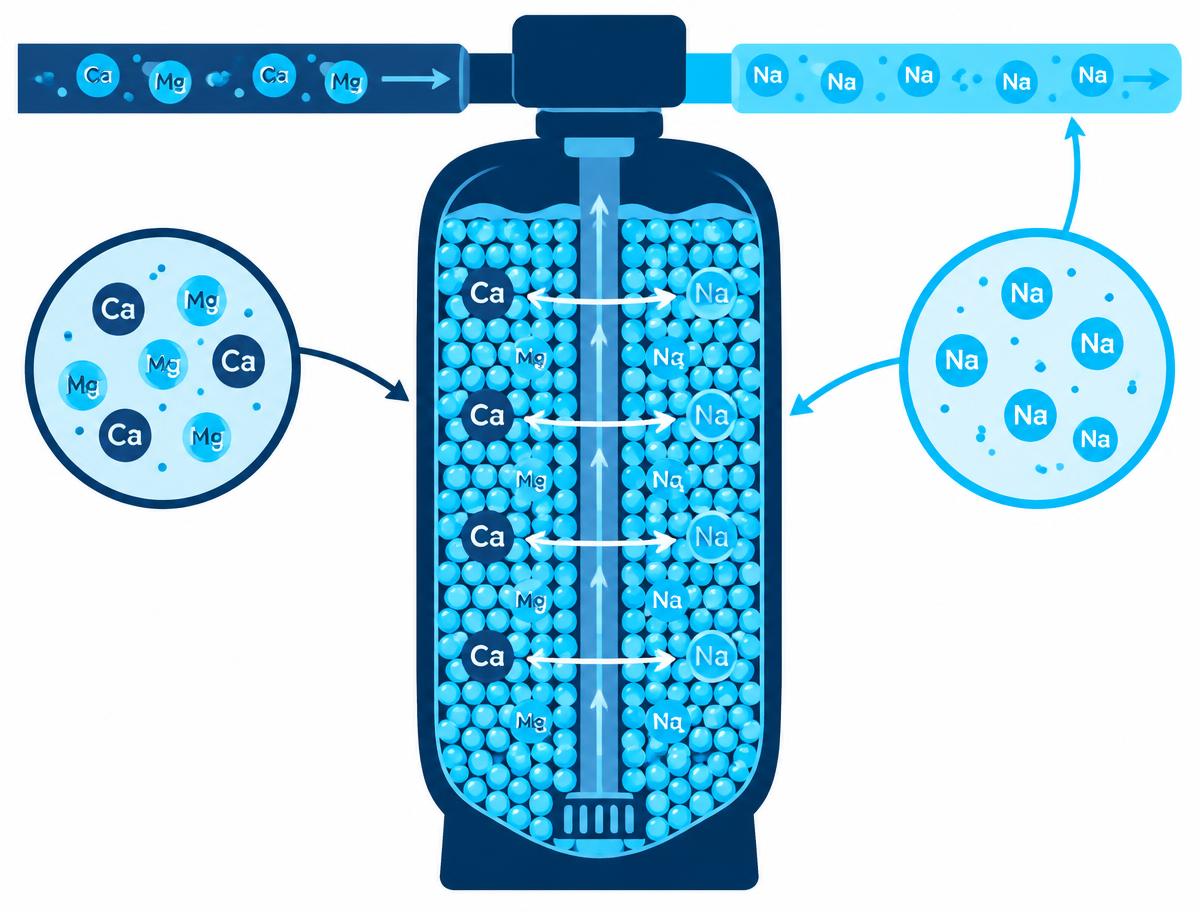
The installer must then relate that load to the selected system's usable capacity at its intended settings, reserve strategy, regeneration approach, and operating requirements. A prominently advertised grain rating is not a complete promise of practical capacity under every salt setting. Oversizing also deserves scrutiny because a larger label does not automatically mean a better fit or better efficiency. Ask how the proposed settings were chosen and what assumptions support them. The softener operation guide provides background on resin, regeneration, and why settings influence the practical result.
Peak flow is a separate check on simultaneous fixtures
Peak service flow asks how much water the treatment arrangement must deliver at once under acceptable operating conditions. Consider an explicitly hypothetical overlap of two showers using 2 gallons per minute each and a faucet using 1.5 gallons per minute. That adds to 5.5 gallons per minute before any other demand is considered. Actual fixture flow rates must be measured or obtained from appropriate specifications. This arithmetic does not prescribe a Plymouth system size, and it does not account by itself for pressure losses or the equipment's treatment performance.
A softener may have sufficient daily capacity yet be poorly matched to a high simultaneous flow. Conversely, a system selected only for a brief peak may create unnecessary cost or other operating compromises if ordinary demand is modest. Review the manufacturer's service-flow information, pressure-drop data, and relevant operating limits for the exact model. Ask whether a quoted flow is a treatment rating, a mechanical maximum, or another metric. Those labels are not interchangeable. A sensible proposal explains both the daily capacity calculation and the peak-flow check instead of presenting one impressive number.
Check pressure and plumbing before blaming equipment size
A weak shower during overlapping use is not automatically proof that the softener is too small. Available supply pressure, pipe dimensions, partly closed valves, clogged cartridges, fixture restrictions, and existing plumbing can all affect delivery. Distinguish static pressure from conditions while water is flowing. A qualified assessment may need pressure readings at relevant locations and observations under representative demand. Replacing a softener without understanding the restriction can leave the original problem unchanged while adding expense and another variable to troubleshoot.
Review the full proposed treatment train, not just one device. A sediment cartridge, carbon stage, softener, and associated valves each have flow characteristics. Their combined effect matters when installed in series. Ask why each stage is included and how it performs at the intended service flow. More equipment is not automatically better treatment, particularly when no measurement or documented goal supports an added stage. The product categories are useful for understanding different functions, but a complete design must account for how the selected components work together in the actual plumbing.
Map outdoor branches and the fixtures that should remain separate
Plymouth planning should include outdoor watering connections because they can affect both treatment load and household priorities. Determine whether irrigation and hose bibs branch off before or after existing equipment. Do not assume an outside faucet is untreated simply because it is outside. If substantial outdoor use passes through a softener, it can change regeneration demand without contributing to the indoor goal the household intended to address. Whether a branch should be changed depends on the plumbing, intended uses, applicable requirements, and a qualified review of the work.
Also identify any drinking-water branch the household wishes to keep separate, along with appliances that have specific water requirements. A conventional sodium-regenerated softener exchanges hardness ions and can add sodium; dietary questions belong with an appropriate healthcare professional. Do not impose a universal branch layout based only on a general article. A useful diagram shows incoming water, the bypass, treated indoor branches, any intentionally separate branches, and shutoff locations. That drawing helps everyone distinguish a deliberate design choice from an accidental connection discovered after installation.
Compare household scenarios without treating them as local measurements
In a hypothetical smaller Plymouth townhouse, two occupants might have moderate daily use and little fixture overlap. Their measured hardness and cleaning preferences could lead them to explore softening, but the limited utility area and maintenance access might strongly influence the configuration. Shared-building rules or ownership of the main line could also limit the work they can authorize. This scenario is not a claim about Plymouth townhouses generally. It illustrates why the plumbing arrangement and control of the property matter as much as the household's interest in softer water.
In a different hypothetical detached home, several occupants might regularly overlap showers, laundry, and kitchen use. The important next step would be to quantify representative demand and evaluate the plumbing, not simply select the largest tank available. An existing system might need adjusted settings, service, replacement, or no change depending on the evidence. A third household might decide that its measured hardness does not justify the cost and maintenance for its priorities. A good sizing discussion allows that outcome rather than treating every assessment as a path to a sale.
Keep kitchen drinking-water goals out of the softener sizing shortcut
A household can be satisfied with its showers and laundry while still preferring a different drinking-water taste. That is a separate point-of-use discussion. Carbon filtration may be considered for specific documented taste-and-odor objectives, while reverse osmosis may fit particular dissolved-substance reduction goals. Compare exact model performance rather than assuming a softener resolves both. The reverse osmosis and carbon comparison can help frame the choice. Neither a pleasant taste nor a low total dissolved solids reading should be presented as proof that every possible concern has been addressed.
For a kitchen system, measure cabinet space, review faucet and drain requirements, and consider any refrigerator connection separately. A household drinking system does not need to be sized as though it serves every shower, but it does need to match the intended drinking and cooking use. If PFAS reduction is a stated objective, verify the exact product's applicable independently documented claims, capacity, and replacement conditions. Do not infer performance merely from the words carbon or reverse osmosis. The concern, evidence, and selected system must line up.

Confirm installation details before approving the proposal
A main-line installation needs room for the equipment, access to the bypass and controls, appropriate drainage, and any required electrical connection. Ask the installer to identify applicable permit or inspection responsibilities and how discharge connections will meet local requirements and manufacturer instructions. Service space includes the ability to remove components and refill salt without unsafe lifting or moving unrelated equipment. An arrangement that fits tightly between a furnace and a wall may be inconvenient or unsuitable once required access and other equipment clearances are considered.
The proposal should explain which existing valves and connections can be reused and which require review or replacement. It should also describe shutdown arrangements, startup, leak checks, settings, and homeowner orientation. Ask how the household can bypass the system appropriately if service is needed and what that means for water delivered to fixtures. Do not assume every valve position is obvious from its handle. Clear labeling, retained manuals, and a basic plumbing diagram are practical parts of an installation, especially when future service may be performed by someone unfamiliar with the original work.
Compare cost with the complete operating plan
Use current pricing as the starting point for cost questions rather than relying on a fixed dollar example in an educational article. Request a written scope that identifies equipment, installation work, access challenges, and any optional stages. Compare salt use, regeneration water, replacement cartridges, expected service tasks, and the practical burden of upkeep. These costs depend on the selected system, settings, water conditions, and use. Do not treat an estimated operating figure as a guarantee or assume that the least expensive equipment produces the lowest total ownership cost.
If competing proposals use different sizing assumptions, ask each provider to explain the measured hardness, treated volume, reserve approach, and simultaneous flow used in its recommendation. This makes the comparison more useful than matching tank dimensions or advertised capacity alone. It can also reveal that one proposal includes stages absent from another. The contact page can support a discussion organized around those facts. A submitted request is not itself a confirmed installation appointment, and a preliminary conversation should not be mistaken for a site-specific guarantee about performance or final cost.
Verify operation and maintain the system over time
After installation, ask for the incoming hardness, programmed settings, and an appropriate treated-water check to be documented. Review operation under a representative simultaneous demand rather than judging the work only by whether one faucet runs. That check does not create a blanket performance guarantee, but it helps confirm that the installation and settings correspond to the stated plan. Know where the bypass and shutoffs are, how to recognize normal regeneration, and what observations should prompt service. Keep the startup information where a future technician can find it.
Over time, revisit the assumptions when occupancy, fixture use, or the water supply changes. Follow manufacturer instructions for salt checks, cleaning or sanitizing procedures, replacement parts, and any scheduled testing. A hardness problem after treatment calls for an orderly review of settings, salt availability, valve operation, sampling location, and service condition, not an immediate conclusion that the entire system must be replaced. Plymouth households benefit most from a plan that links measured chemistry, real demand, sound installation, and manageable upkeep while keeping optional treatment genuinely optional.
Sources and further reading
Reviewed October 22, 2026. Utility reports describe the public supply, not an individual household sample. Check the utility for current reports and notices. Images are illustrative, not photographs of a customer installation.
Frequently asked questions
Does Plymouth's municipal treatment mean a household softener is unnecessary?
Not necessarily, and it also does not mean every home needs one. Plymouth describes disinfection and iron and manganese removal, which are different functions from household softening. Measure incoming hardness and compare it with your goals, existing treatment, and willingness to maintain equipment. The decision should address a useful household outcome rather than assume municipal treatment and a softener perform the same job.
Why can a softener have enough capacity but still be poorly sized?
Capacity between regenerations and simultaneous service flow answer different questions. A system may handle the expected daily hardness load yet be a poor match for the flow demanded when several fixtures operate together. The exact model's operating information, pressure losses, and the home's plumbing all matter. Ask for both the daily-load calculation and the peak-flow review instead of relying on an advertised grain rating.
Should I size by the number of bathrooms?
Bathroom count can begin the conversation, but it is not a complete demand assessment. Occupancy, actual fixture flow, overlap, appliance fills, outdoor branches, and daily water use can differ greatly between otherwise similar homes. Identify representative simultaneous use and verify fixture information. A proposal should explain its assumptions rather than use bathroom count as an automatic instruction to purchase a particular tank.
Will a larger softener fix low water pressure?
Not automatically. Low delivery during demand can involve supply pressure, plumbing restrictions, valves, cartridges, or fixtures as well as treatment equipment. A qualified review should distinguish static pressure from conditions while water flows and locate relevant restrictions. Replacing equipment without that diagnosis can leave the problem unresolved. Larger advertised capacity is not a substitute for checking the full plumbing and treatment arrangement.
What information makes a Plymouth sizing discussion more useful?
Bring incoming hardness with units and sample location, existing equipment details, household occupancy, representative overlapping fixture use, utility-room photographs, and a branch diagram if available. Note outdoor watering connections and any specific drinking-water goal separately. These details support a focused comparison while leaving room for a site assessment, additional measurements, and a decision that some proposed equipment is unnecessary.
More from the blog
Does a City-Softened Minneapolis Home Need Extra Water Treatment?
Minneapolis already softens its municipal water. Here is how to decide whether additional household treatment serves a real purpose.
Saint Paul Drinking-Water Taste: Kitchen Filter or Main-Line Treatment?
A kitchen taste preference and a whole-home treatment goal are different projects. Learn how to compare them in an existing Saint Paul home.
Bloomington Water Treatment for Houses and Condos: Know Your Plumbing
Bloomington's combined municipal supply is only part of the decision. Your plumbing boundary and maintenance authority determine which options fit.
Edina or Morningside? Plan the Right Water Treatment for Your Remodel
Edina's two water systems make address-level planning important. Learn how to connect your supply, household measurements, and kitchen remodel decisions without assuming every home needs the same equipment.
Talk through your water with a local pro
A free phone consultation starts with your water source and your goals. Published installed pricing, kitchen reverse osmosis included with every whole-home package, and a best-price guarantee.