
Minnesota Water Pros blog
Woodbury, Minnesota · Local service informationWoodbury Water Filters: Read Utility Updates Before You Choose
Published October 22, 2026 · 13 min read · Educational content only, not a water quality diagnosis.

In this guide
- Read Woodbury's official utility information in context, keeping report years, sampling dates, project milestones, and current notices separate.
- Do not infer present PFAS concentrations, address-specific conditions, or completed municipal treatment from an older report or a construction announcement.
- Translate a household concern into an exact performance question, then verify the complete filter model and its documented reduction claim.
- Evaluate hardness, kitchen preferences, and whole-home treatment as different decisions with different measurements and maintenance obligations.
- Compare installation scope, rated capacity, replacement access, and ongoing costs before choosing a focused drinking-water system or a broader plan.
What EWG's Tap Water Database Shows for Woodbury
The Environmental Working Group (EWG) compiles utility testing results supplied by the Minnesota Department of Health. Its listing for the Woodbury water system, which EWG shows serving about 82,643 people from groundwater with data from 2014 to 2024, reports 26 contaminants detected, 12 of them at levels above EWG's health guidelines. The largest gaps EWG lists are Perfluorooctanoic acid (PFOA) (about 112 times the guideline), Haloacetic acids (HAA9) (about 57 times the guideline), and Total trihalomethanes (TTHMs) (about 37 times the guideline). Several of the listed items are disinfection byproducts, which form when the chlorine that keeps water safe in the pipes reacts with natural organic matter. We reviewed this listing on October 22, 2026, and you can read the full breakdown on [EWG's Woodbury page](https://www.ewg.org/tapwater/system.php?pws=MN1820025).
Context matters. EWG's guidelines are its own health benchmarks and are often far stricter than federal legal limits, and many of the listed substances have no legal limit at all. For the most recent quarter EWG reports from the U.S. EPA (April to June 2024), this system was in compliance with federal health-based drinking water standards. Utility data describes the public supply, not the water at your tap, so it is a starting point for a conversation rather than a verdict on your home. If any listed item matters to your household, match it to equipment certified to reduce that specific substance, and compare the Minneapolis and St. Paul snapshots on our water quality page.
Begin with the right Woodbury documents
Woodbury's 2025 drinking-water report identifies a groundwater supply from the Jordan aquifer. The city also publishes information about its water-treatment project. Those are related sources, but they answer different questions. An annual report describes monitoring and utility information for a defined reporting period. A project page may describe design, construction, planned treatment, or operating milestones. Neither should be read as a household test result. Begin at the city's official water-treatment page, follow its links to relevant reports and notices, and retain the publication or update date beside any statement you use. This guide does not assert current PFAS concentrations or a current project-completion status.
It is easy to combine separate statements into a conclusion the city did not make. A description of planned treatment technology does not prove that every component is operating. A construction milestone does not establish the water conditions at every address. A prior annual result does not establish a present household concentration. When a page uses words such as planned, expected, underway, or operational, preserve that distinction. If status affects your decision, ask the utility for the latest applicable information rather than filling the gap with an assumption. The Woodbury service-area page provides local planning context, while official utility communications remain the source for utility status.
Separate publication dates, sampling dates, and project dates
A useful reading method is to write three dates on a notepad: when the document was published, when the reported water samples were collected, and when any described project activity occurred or is expected. These dates may differ substantially. A report released in one year can summarize monitoring from an earlier period, and a project update can discuss a future milestone. Do not label all of those facts current simply because the webpage remains available. Where a statement lacks a clear date, treat that as a reason to ask a question rather than as evidence that the statement describes today's operating conditions.
Also record what the document actually covers. Is it a system-wide summary, a treatment facility update, a specific sampling location, or guidance to customers? Is a number a measured result, a range, a reporting limit, or a regulatory value? These distinctions change how the information can be used. Avoid comparing unlike units or assuming a nondetection means absolute absence. If an unfamiliar abbreviation appears, use the report's definitions and ask the utility to explain unresolved details. The purpose is not to become a water chemist before making a household decision. It is to avoid buying equipment based on a misread table or a headline detached from its context.
- Identify the official publisher, document title, reporting period, and most recent stated update date before extracting a claim.
- Keep measured results separate from regulatory limits, proposed goals, analytical reporting limits, and construction milestones.
- Note whether the information describes the public system generally or a particular location, and do not convert it into an address-specific result.
- Follow any active utility instructions directly; optional household equipment planning should not replace or reinterpret those instructions.
Turn a concern into a specific treatment question
A statement such as we want better water is too broad to evaluate. Replace it with a question that identifies the desired outcome and the location: a taste preference at the kitchen tap, measured hardness affecting connected fixtures, or reduction of a named substance in drinking water. Each calls for different evidence. Taste can be a preference without indicating a safety problem. Hardness calls for a hardness measurement. A substance-specific concern calls for relevant utility information, appropriate testing when warranted, and documented equipment performance. Do not assume that a device that changes taste also achieves a separately desired contaminant reduction.
Consider a hypothetical Woodbury homeowner reading a project update and deciding whether to install a kitchen system. The sensible next step is not automatically to buy the most elaborate package. First identify the exact unresolved question, check whether the utility has addressed it in a newer notice, and decide what household treatment outcome is being sought. If a reduction claim matters, compare models against that claim. If the main issue is hardness, investigate that independently. This example does not imply any present exposure, concentration, or advisory. It illustrates how a careful decision process can proceed without assuming facts that have not been established.
Verify the complete model, not just the technology name
Terms such as carbon filter, reverse osmosis, and multistage system describe broad treatment categories. They do not establish identical performance across products. Ask for the full model number, the exact replacement elements, the manufacturer's performance data sheet, and any independently verifiable certification listing supporting the proposed claim. A recognized standard can cover multiple possible claims, so the standard's name alone is not enough. Confirm that the listing identifies the reduction you care about for the complete system being offered. A certified component inside an otherwise different assembly should not be represented as proof that the entire installed arrangement carries the same claim.
Read the conditions attached to performance. Rated flow, service capacity, incoming pressure, temperature, and required maintenance may affect whether the product is suitable. A percentage-reduction statement without its test conditions can be misleading, particularly when used to imply performance for an unrelated starting concentration or an indefinitely extended cartridge life. Ask how the manufacturer's documented conditions compare with your intended use. The reverse osmosis versus carbon guide explains the broad process differences, but the final comparison still needs exact model documentation. More stages, a larger housing, or a premium product name is not a substitute for an applicable reduction claim.
Handle PFAS questions without automatic claims
PFAS questions deserve precision rather than reassurance based on a generic media label. Do not assume that every carbon product reduces PFAS, that all PFAS are covered by one claim, or that every reverse osmosis unit has the same documented performance. Request the specific substances or applicable claim covered by the model's documentation, the rated capacity for that claim, and the required replacement conditions. If information is unclear, the claim remains unverified. Municipal treatment decisions and household product documentation also should not be conflated. A city project can have a different design, operating oversight, and objective from a cartridge under a kitchen sink.
If testing is appropriate for a particular household question, discuss the sampling plan with a qualified laboratory before collecting water. Specialized analyses may have specific containers, handling instructions, and methods. A routine hardness test, a taste observation, or an inexpensive dissolved-solids meter cannot establish PFAS concentration. A test result also needs its sampling location and date to be meaningful. When comparing untreated and treated water, document which fixtures were used and whether the system was operating normally. This guide intentionally provides no current Woodbury PFAS number, no claimed household exposure level, and no assumption that a utility project has reached a particular completion milestone.

Evaluate hardness on its own track
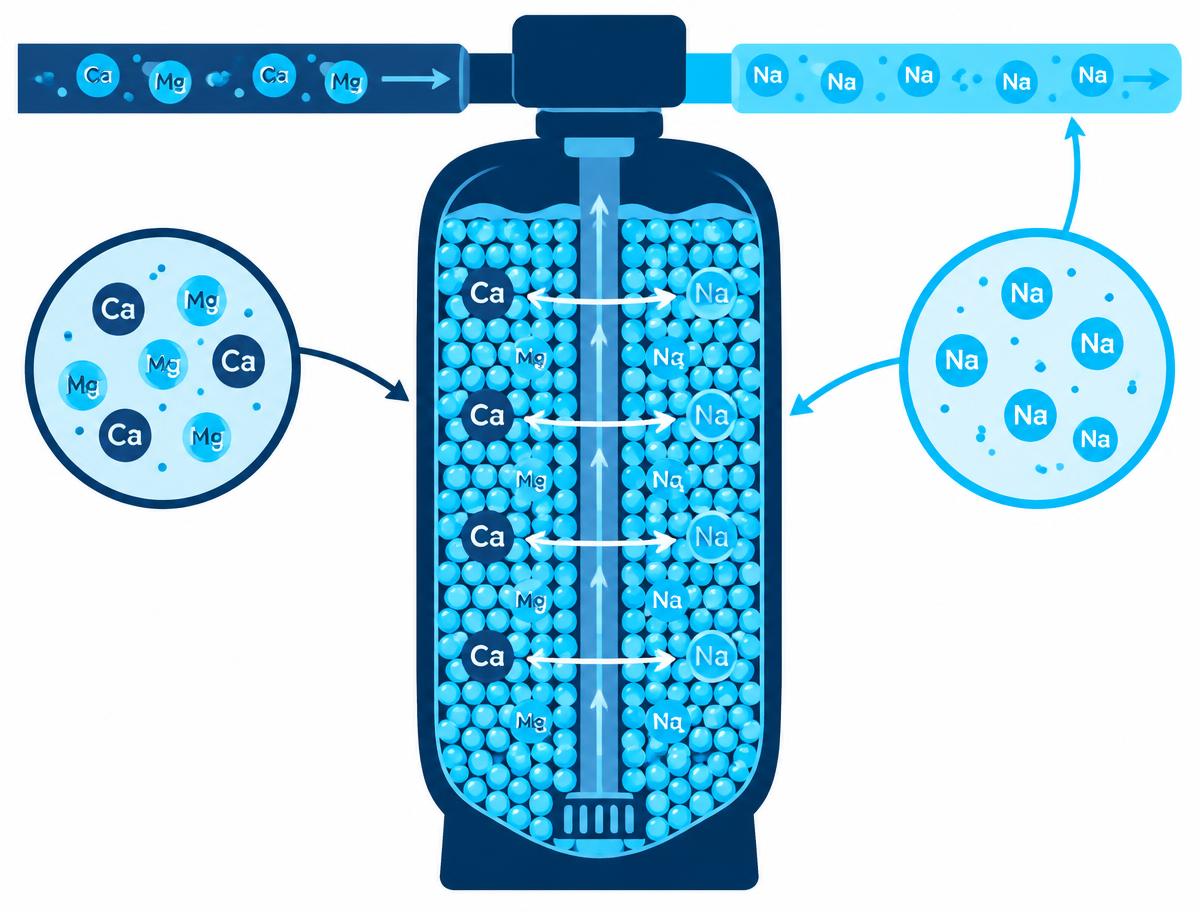
A water softener reduces hardness minerals, principally calcium and magnesium, through ion exchange. It is not a universal contaminant filter and should not be offered as an automatic answer to PFAS concerns. Minnesota Department of Health guidance describes softening as an optional household choice. Obtain an incoming hardness measurement, retain its units, and connect the result to the issues you want to address. Scale, spotting, and cleaning preferences are a different discussion from a named drinking-water reduction claim. A homeowner can reasonably investigate softening without adding kitchen filtration, or investigate kitchen filtration without deciding that whole-home softening is necessary.
If a softener already exists, identify its model, age, settings, maintenance history, and bypass position. Suitable before-and-after hardness measurements can help evaluate its operation. Do not mistake a functioning softener for proof that other substances have been reduced, and do not mistake a kitchen filter for a whole-home hardness solution. Sizing should account for measured hardness, household use, service flow, and regeneration requirements. Ask about salt and water use without expecting identical operating costs across homes. Keeping this track separate makes proposals easier to compare because every treatment stage must justify its own purpose rather than borrowing credibility from another stage.
Choose point-of-use or whole-home scope deliberately
A dedicated kitchen system treats the water routed through that outlet, and sometimes a specifically connected refrigerator line. It does not automatically treat other drinking taps, bathroom sinks, or the rest of the house. Whole-home equipment treats the water passing through its main-line location, but bypassed branches and outdoor connections need to be identified. Neither scope is inherently superior. The appropriate scope follows the established goal, the product's documented suitability, and the plumbing arrangement. Ask an installer to trace what will and will not be treated instead of relying on the phrase whole home as though it guarantees every fixture receives identical treatment.
Main-line equipment also has to support household flow without unacceptable pressure loss. Under-sink equipment needs adequate cabinet clearance, a suitable faucet arrangement, accessible shutoffs, and any required drain connection. Reverse osmosis systems differ in storage design, production rate, and pressure requirements, so compare those specifications against how you fill pots, bottles, and other containers. A household may prefer a focused kitchen installation because that matches its goal and maintenance capacity. Another may have a justified broader concern. The whole-house filter planning article can help identify installation factors, but it should not be used to infer that a broader treatment scope is necessary.
Make replacement conditions part of the performance claim
Filter performance cannot be separated from maintenance. The rated capacity for a specific reduction claim may differ from a general taste-and-odor replacement suggestion. Ask which condition controls replacement, such as elapsed time, treated volume, a monitoring indicator, or another manufacturer-defined limit. Do not keep a cartridge in service beyond the documented conditions simply because the water still tastes acceptable. An indicator light also needs interpretation: some devices track time or volume rather than directly measuring contaminant breakthrough. The proposal should explain what the indicator actually means and what the homeowner must do when it signals a change.
Confirm that exact replacement elements are available and that substitutions will not invalidate the intended performance documentation. Ask how housings are sanitized, how leaks are checked, and whether the homeowner can perform replacements safely. For reverse osmosis, distinguish prefilters, postfilters, and the membrane rather than accepting one unexplained annual service line item. Keep a log with installation date, cartridge changes, model identifiers, and any test results. If you travel or leave a home unused for extended periods, ask for the manufacturer's stagnation and restart instructions. A clear service routine is a practical requirement, not an optional accessory to an otherwise complete treatment decision.
Compare evidence and lifecycle scope before comparing totals
Start your budget with the documented goal and treatment location. Then compare current options on the pricing page, using a written site-specific scope where needed. Include plumbing modifications, faucet installation, electrical requirements if applicable, startup, consumables, and service expectations. Ask whether quoted maintenance assumes homeowner labor or paid visits. Avoid promised savings or statements that a particular purchase will eliminate every future water expense. The useful comparison is between systems capable of meeting the same defined goal under suitable conditions. A less expensive product with an unrelated claim is not an equivalent alternative, and a more expensive package is not automatically more appropriate.
Use the product catalog to organize candidates, then request missing documentation before selecting one. A good proposal identifies the complete model, its intended claim, installation inclusions, maintenance conditions, warranty terms, and what remains outside its scope. It should also explain what can be verified at startup and whether later laboratory testing is appropriate for your particular concern. Do not confuse a successful leak check or a low dissolved-solids reading with verification of every reduction claim. If the proposal depends on a utility-project assumption, ask for the current official source supporting that assumption or have the proposal rewritten without it.
A practical Woodbury next step
- Save the official utility documents you reviewed and record their publication dates, sampling periods, and stated project status without merging them.
- Write one primary household goal and identify which outlets need treatment; measure hardness separately if softening is being considered.
- Request exact model documentation, applicable independent listings, rated capacity, flow requirements, and replacement-element identifiers.
- Bring the documents and plumbing photographs to a consultation, and ask which questions require the utility, a laboratory, or an installer to answer.
You can begin a discussion through the contact page without treating that step as a commitment to buy. Bring the specific report or notice that prompted your question, rather than only a remembered headline. Keep any active official instructions at the center of the conversation, and separate them from optional preferences about taste, hardness, and convenience. The strongest Woodbury treatment plan is an evidence chain: an accurately read utility document, a clearly defined household goal, an appropriate product claim, a suitable installation, and maintenance that preserves the documented conditions. None of those links should be replaced by assumptions about current concentrations or municipal project completion.
Sources and further reading
Reviewed October 22, 2026. Utility reports describe the public supply, not an individual household sample. Check the utility for current reports and notices. Images are illustrative, not photographs of a customer installation.
Frequently asked questions
Does this guide establish Woodbury's current PFAS concentration?
No. It provides no current concentration and no household exposure determination. Consult the city's latest applicable information and ask the utility about unresolved questions. An older annual report describes its own reporting period, while a household result requires an appropriate sample and analysis. Neither should be silently converted into a statement about today's water at every address.
Can I assume a treatment project is finished because construction was announced?
No. Planned work, construction progress, commissioning, and ongoing operation are different statuses. Use the city's stated language and update date, and request clarification when status matters to your decision. This guide does not assume that a particular project milestone has been reached or that every source or customer is affected in the same way.
What evidence should support a household PFAS reduction claim?
Ask for the complete system model, exact applicable claim, performance data, rated capacity, operating conditions, and independently verifiable certification listing when certification is represented. Check the substances or claim actually covered. A generic carbon description, a component certification, or the phrase reverse osmosis is not enough to establish the complete installed system's performance.
Does softening address the same problem as drinking-water filtration?
Not generally. Softening reduces hardness minerals and should be evaluated using hardness measurements and household preferences. Drinking-water filters must be selected for their own documented purposes. A softener is not a universal contaminant filter, and a point-of-use drinking-water system does not automatically change hardness at showers, washing machines, or other unconnected fixtures.
Can good taste tell me when a cartridge still works?
Good taste does not verify a specific reduction claim or remaining capacity. Follow the manufacturer's replacement conditions for the claim you rely on. Ask whether an indicator measures time, volume, or something else. Keep replacement records, use the specified elements, and do not extend service life solely because no taste change is noticeable.
Should I choose a kitchen system or whole-home treatment?
Choose the scope that matches the established goal, applicable performance documentation, and plumbing. A kitchen system can be focused on drinking and cooking water, while main-line equipment treats connected downstream branches. Broader scope adds flow and maintenance considerations. Neither is automatically required merely because the city publishes treatment-project updates.
More from the blog
Does a City-Softened Minneapolis Home Need Extra Water Treatment?
Minneapolis already softens its municipal water. Here is how to decide whether additional household treatment serves a real purpose.
Saint Paul Drinking-Water Taste: Kitchen Filter or Main-Line Treatment?
A kitchen taste preference and a whole-home treatment goal are different projects. Learn how to compare them in an existing Saint Paul home.
Bloomington Water Treatment for Houses and Condos: Know Your Plumbing
Bloomington's combined municipal supply is only part of the decision. Your plumbing boundary and maintenance authority determine which options fit.
Edina or Morningside? Plan the Right Water Treatment for Your Remodel
Edina's two water systems make address-level planning important. Learn how to connect your supply, household measurements, and kitchen remodel decisions without assuming every home needs the same equipment.
Talk through your water with a local pro
A free phone consultation starts with your water source and your goals. Published installed pricing, kitchen reverse osmosis included with every whole-home package, and a best-price guarantee.