
Minnesota Water Pros blog
Minnetonka, Minnesota · Local service informationMinnetonka City Water Is Not Softened: What Should You Do?
Published October 22, 2026 · 13 min read · Educational content only, not a water quality diagnosis.

In this guide
- Verify the actual water connection using property and utility information rather than neighborhood appearance, a lake address, or assumptions about nearby homes.
- Minnetonka states that municipal treatment does not reduce hardness, so a household measurement helps evaluate optional softening.
- For a confirmed private well, use current well-specific testing and official guidance rather than treating the city's report as evidence about that well.
- Separate hardness management from iron concerns, microbial questions, taste preferences, and named drinking-water reduction goals.
- Compare installation scope, service access, maintenance responsibilities, and current pricing only after the source and treatment purpose are clear.
What EWG's Tap Water Database Shows for Minnetonka
The Environmental Working Group (EWG) compiles utility testing results supplied by the Minnesota Department of Health. Its listing for the Minnetonka water system, which EWG shows serving about 54,474 people from groundwater with data from 2013 to 2024, reports 27 contaminants detected, 10 of them at levels above EWG's health guidelines. The largest gaps EWG lists are Haloacetic acids (HAA9) (about 252 times the guideline), Total trihalomethanes (TTHMs) (about 176 times the guideline), and Perfluorohexane sulfonate (PFHXS) (about 138 times the guideline). Several of the listed items are disinfection byproducts, which form when the chlorine that keeps water safe in the pipes reacts with natural organic matter. We reviewed this listing on October 22, 2026, and you can read the full breakdown on [EWG's Minnetonka page](https://www.ewg.org/tapwater/system.php?pws=MN1270031).
Context matters. EWG's guidelines are its own health benchmarks and are often far stricter than federal legal limits, and many of the listed substances have no legal limit at all. For the most recent quarter EWG reports from the U.S. EPA (April to June 2024), this system was in compliance with federal health-based drinking water standards. Utility data describes the public supply, not the water at your tap, so it is a starting point for a conversation rather than a verdict on your home. If any listed item matters to your household, match it to equipment certified to reduce that specific substance, and compare the Minneapolis and St. Paul snapshots on our water quality page.
Your first Minnetonka question is about the connection
Before discussing a softener or filter, establish whether the property receives municipal water or uses a private well. Minnetonka's wooded neighborhoods, landscaped lots, and lake-area addresses do not answer that question. Neither does the water source used by a nearby home. Review utility billing, property records, available well records, and the home's plumbing arrangement. If the evidence is unclear, ask the city or an appropriate well professional to help verify it. A visible well casing might relate to a different use or an inactive well, so its presence alone should not substitute for confirmation of the water actually supplying the kitchen and bathrooms.
This source check changes the rest of the process. Municipal customers can begin with the city's published drinking-water information and relevant household measurements. Private-well owners need evidence about their own well, including appropriate current testing. A city report cannot establish the quality of an unconnected private well, and a neighbor's well result cannot establish conditions at yours. The Minnetonka service-area overview highlights that distinction because it prevents an otherwise detailed equipment comparison from starting with the wrong premise. If the property has more than one supply arrangement, document which source serves each use before choosing treatment or interpreting a sample.
What Minnetonka says its municipal treatment does
Minnetonka lists municipal treatment steps that include disinfection, fluoridation, iron removal, and corrosion control. The city also states that its treatment does not reduce hardness. Those statements explain why treated city water and softened household water are not interchangeable descriptions. Municipal treatment serves public-supply objectives, while a household softener is a separate decision about hardness minerals. Do not interpret the absence of municipal softening as evidence that the city's water is untreated, and do not interpret municipal treatment as proof that no household could find softening useful. The relevant question is what remains at your connection and whether changing it serves a household goal.
Use the applicable city report with its stated reporting period, and check for notices relevant to the concern you are investigating. The report is a public-system reference, not a diagnosis of every fixture in every home. Building plumbing, an existing softener, a kitchen filter, or a bypassed branch can affect what a particular sample represents. If you inherit treatment equipment, identify it before attributing the water's characteristics to the city alone. Keep a simple source-and-treatment sketch showing the incoming line and downstream stages. This makes it easier to ask useful questions and avoids selecting new equipment to duplicate a function already being performed elsewhere.
Measure hardness even though the city does not soften
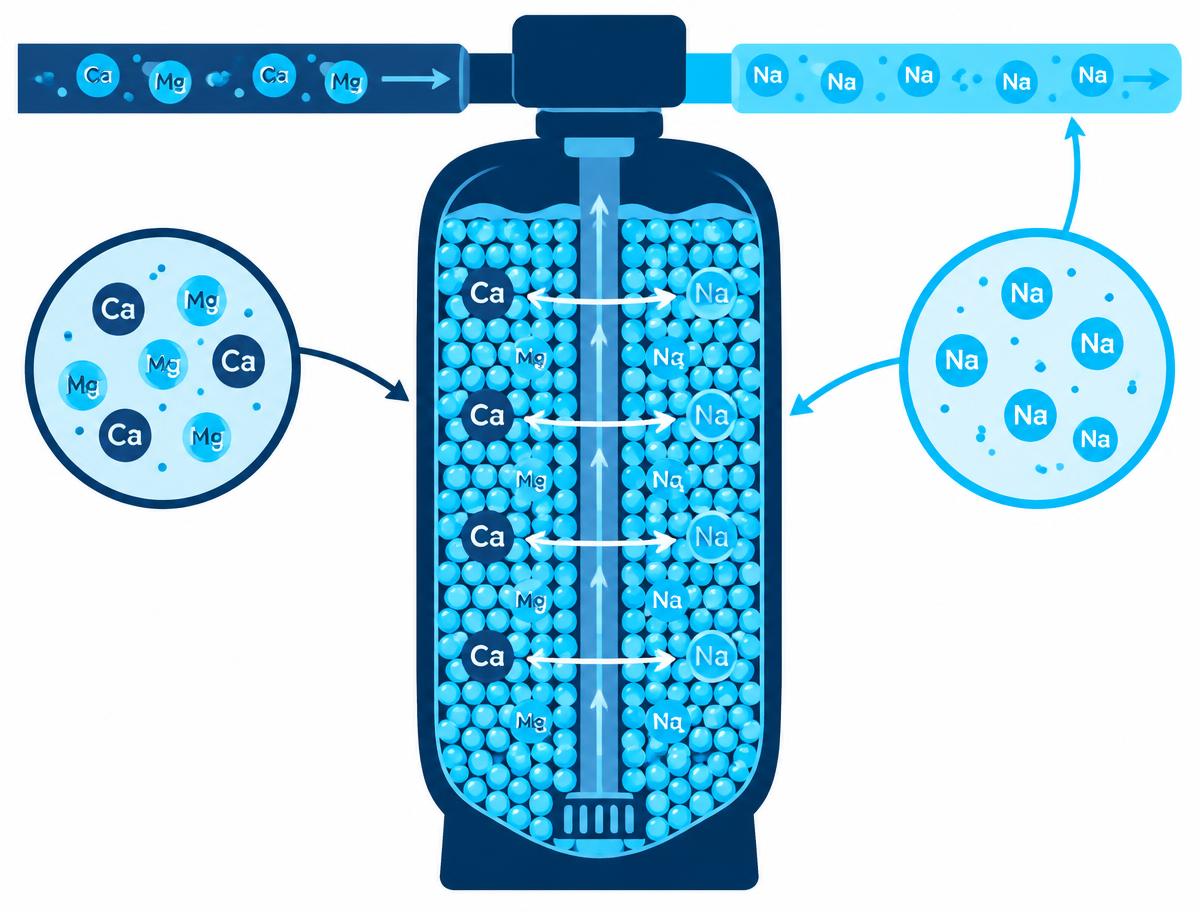
The city's statement that it does not reduce hardness is a reason to measure, not a reason to assign every home the same number. Hardness primarily reflects calcium and magnesium, and commonly appears as grains per gallon or milligrams per liter as calcium carbonate. Retain the units and sampling point with the result. One grain per gallon is approximately 17.1 milligrams per liter. If a household softener is present, a sample from a softened tap may not describe the incoming supply. Ask for appropriate before-and-after sampling points rather than assuming a garden faucet or kitchen cold line is untreated.
Minnesota Department of Health guidance describes softening as an optional household choice rather than a general requirement for safe water. Connect the hardness result to your actual priorities: fixture deposits, cleaning preferences, appliance instructions, or the way you want water delivered to particular fixtures. Avoid treating skin symptoms, taste, or a photograph of residue as a hardness measurement or a medical diagnosis. The hard water versus soft water guide explains the basic distinction, but household selection still requires measured conditions, demand, and a suitable installation. You may decide to soften, keep existing equipment, investigate a fault, or make no immediate change.
- Confirm whether the sample is before or after existing treatment and record the bypass position when relevant.
- Keep hardness units, sampling date, location, and method together so the result can be interpreted and compared later.
- If a softener is present, review its model, settings, regeneration history, and service records before assuming it needs replacement.
- Separate hardness preferences from any substance-specific or microbial question, because those require different evidence and treatment considerations.
For a confirmed well, build a well-specific evidence file
If the property uses a private well, collect available construction records, prior laboratory reports, maintenance history, and information about existing treatment. Then discuss an appropriate current testing plan with a Minnesota-accredited laboratory or the relevant public-health resource. Use official Minnesota Department of Health guidance for routine and circumstance-specific testing, rather than ordering only the tests associated with a product someone wants to sell. The Minnesota well-water treatment guide can help organize the treatment conversation, but the well's own evidence must drive the plan. A municipal report, a real-estate listing, or a clear-looking glass is not a substitute for that evidence.
Follow the laboratory's sampling instructions exactly, including container, collection point, timing, preservation, and delivery requirements. Tests can answer different questions, and a sample taken after existing treatment may not describe the untreated well. Ask whether you need a source sample, a drinking-tap sample, or both for the question at hand. When official guidance calls for action after an event such as well damage or flooding, follow that guidance rather than assuming routine household filters are adequate. This guide does not declare a particular well safe or unsafe. It explains why source verification and properly selected testing must precede an equipment recommendation.
Do not confuse well protection with treatment
Well maintenance and water treatment are related but separate responsibilities. Minnesota Department of Health guidance emphasizes protecting the well, keeping potential contamination sources away, and addressing damage. A filter does not repair a cracked casing, correct every construction issue, or eliminate the need for well maintenance. If there is a suspected structural or sanitary problem, involve an appropriate well professional and follow official instructions. Buying another treatment stage should not become a way to avoid investigating the source of a problem. Keep well records and treatment records together, but be clear about which professional is evaluating which part of the system.
The same distinction applies to changes in appearance or odor. A new symptom can justify investigation without identifying its cause. Do not assume every stain is iron, every smell has the same source, or a change after filtration proves that all relevant concerns have been resolved. A qualified assessment may consider testing, the well, household plumbing, the water heater, and existing treatment. If a laboratory or public-health agency recommends an immediate action, follow that instruction directly. Optional equipment comparisons can come afterward. This approach avoids making unsupported diagnoses and helps ensure that treatment is selected for a defined problem rather than for a guessed explanation.
Match each treatment category to a distinct job
A softener reduces hardness minerals through ion exchange. Its suitability can be affected by other water characteristics and by the selected equipment's limits, so do not assume it also solves every iron or manganese concern. A sediment stage addresses particles within its rating, not every dissolved substance. Carbon systems vary by media and design and must be judged against documented claims. A private-well treatment plan may require a different approach from a municipal-water preference, even when both households describe the water as unpleasant. Each proposed stage should have a named purpose, a basis in evidence, and an explanation of how performance will be checked.
Avoid using a familiar technology name as a shortcut to a complete recommendation. A filter marketed for taste is not automatically documented for a named contaminant. Generic carbon is not an automatic PFAS-reduction claim. A softener should not be represented as a general microbial treatment, and a standard kitchen reverse osmosis system should not be presumed to make an otherwise unsuitable source acceptable. If a verified well concern requires specialized treatment, discuss the appropriate design, monitoring, and ongoing testing with qualified professionals. The objective is not to assemble the most stages. It is to create a coherent system in which every stage addresses a justified need under suitable operating conditions.
Consider the kitchen separately from whole-home hardness
A household may want softened water for connected fixtures and still evaluate drinking-water preferences independently. Another may want only a kitchen system and have no interest in changing shower or laundry water. A dedicated drinking tap can focus treatment on water used for beverages and cooking, but it does not automatically serve bathroom taps or every refrigerator. Trace the actual connections. For any selected kitchen system, obtain the exact model's performance documentation, rated capacity, replacement requirements, and applicable certification listing when certification is claimed. Compare those details against the intended goal instead of assuming that every model in a broad product category has the same capabilities.
Reverse osmosis uses a membrane with associated stages and has practical requirements that deserve attention. Check incoming pressure, production rate, storage or dispensing arrangement, drain connection, faucet space, and cartridge-removal clearance. Where a manufacturer reports efficiency or reject-water information, read the stated test conditions rather than assuming the same performance under every household condition. A low dissolved-solids reading can be useful for limited operational checks but does not verify every substance-specific reduction claim. For a private-well source, confirm that the complete treatment plan provides an appropriate feed to the kitchen system rather than asking an under-sink device to compensate for unresolved source problems.

Plan plumbing and service access before choosing a model
A municipal-water installation and a private-well installation can have different upstream equipment and operating conditions. Document the incoming line, existing pressure equipment where present, shutoffs, treatment order, bypasses, and outdoor branches. Ask the installer to explain why the proposed order is suitable rather than assuming every tank can be placed anywhere. Main-line equipment must support actual simultaneous demand with acceptable pressure loss. Include the fixtures that regularly operate together, but do not size solely by resident count or the largest available tank. If there is an existing pressure problem, identify it before attributing it to hardness or assuming treatment will correct it.
Review drainage, electrical requirements, clearances, and local code or permit requirements for the selected system. A softener drain needs an appropriate arrangement and required protection against cross-connections. An under-sink system needs accessible shutoffs and enough room to remove cartridges without dismantling the cabinet. Service access includes practical tasks such as carrying salt, lifting a lid, handling a filter housing, and inspecting for leaks. Ask for a layout that remains workable after the utility room fills with ordinary household storage. A system that fits on installation day but cannot be maintained safely is not a well-planned installation.
Budget after source verification, not before
The first justified expense may be testing, a service assessment, or confirmation of the supply arrangement. Once the goal is clear, review the pricing page for current options and request a written scope for the actual property. Include equipment, plumbing, startup, disposal where relevant, and required site work. Private-well testing and well repairs should not be hidden inside an unexplained filtration total. Nor should a municipal customer be sold well-specific equipment merely because the property has a rural appearance. Keep each cost tied to a defined task so you can decide which work is necessary now and which optional improvement can wait.
Compare recurring obligations as carefully as the installation price. Depending on the design, these can include salt, cartridges, membranes, media, monitoring supplies, laboratory testing, service visits, and water used during treatment. Ask for the assumptions behind any annual estimate. Do not expect guaranteed savings from detergent changes, appliance life, or reduced bottled-water purchases. Those outcomes depend on the household and should not be promised as payback. Browse the product catalog only after narrowing the treatment category, then compare products capable of doing the same defined job. A less expensive unrelated device and a more elaborate package are not equivalent alternatives simply because both are labeled water treatment.
Assign maintenance and verification responsibilities
Before approving a proposal, decide who will maintain the system and what records will be kept. Softener upkeep may include salt checks, settings review, and attention to regeneration behavior. Filter upkeep may include cartridge changes, sanitation, flushing, and leak checks. A well-based plan may also require ongoing source testing and well maintenance independent of the treatment schedule. Ask which tasks the homeowner can perform and which require a qualified professional. Do not rely on taste alone to determine cartridge life or use a generic calendar interval when a specific reduction claim has different rated conditions. Keep exact replacement identifiers to avoid unsuitable substitutions.
- Request a source-and-treatment diagram identifying what each stage does and which fixtures or branches bypass it.
- Keep laboratory reports, hardness measurements, model numbers, maintenance instructions, and warranty documents in one accessible file.
- Ask how startup performance will be checked and which later questions require a laboratory result rather than a visual inspection or meter reading.
- Establish a maintenance schedule that separates treatment upkeep, well protection where applicable, and responses to official utility or public-health instructions.
Take the smallest well-supported next step
Consider two hypothetical properties with similar kitchens. One is confirmed on city water and has measured hardness that the owner wants to manage. The other uses a private well and has no current testing. Their first steps should differ even if both owners ask for a filter. The municipal household can evaluate optional softening and kitchen goals using city context and measurements. The well household first needs an appropriate source-specific evidence base. These examples do not describe any actual installation. They show why an address, a lake view, or a product preference cannot replace source verification. Bring what you know to the contact page, identify what remains unknown, and build the plan from there.
Sources and further reading
Reviewed October 22, 2026. Utility reports describe the public supply, not an individual household sample. Check the utility for current reports and notices. Images are illustrative, not photographs of a customer installation.
Frequently asked questions
Does Minnetonka soften municipal water?
The city states that its municipal treatment does not reduce hardness. Its listed treatment steps include disinfection, fluoridation, iron removal, and corrosion control. That does not assign a single hardness value to every household faucet. Measure at an appropriate location, account for existing treatment, and decide whether optional household softening serves your preferences.
Can a lake-area address tell me whether a home uses a well?
No. Confirm the actual supply through utility and property information and, when needed, city or well-professional assistance. Nearby homes may have different arrangements. A visible well also needs context because it may be inactive or serve a different use. Selection should follow the source actually supplying the household fixtures.
Can a private-well owner use Minnetonka's report instead of testing?
No. The municipal report describes the public system, not an unconnected private well. Use current well-specific testing selected with official guidance and an appropriate laboratory. Follow sampling instructions and identify whether the sample is untreated or taken after existing treatment. A neighboring well's result also does not establish conditions at your property.
Will a softener also solve iron, microbial, and drinking-water concerns?
Do not assume that. Softening principally addresses hardness, and other water characteristics must be evaluated against the equipment's limits. Microbial questions and named substance concerns require their own evidence and appropriate treatment planning. Each proposed stage should have a distinct documented purpose rather than being represented as a universal solution.
Should kitchen reverse osmosis be selected before well testing?
For a confirmed private well without adequate current information, establish the source-specific evidence first. The kitchen system must be compatible with its feedwater and intended goal. A standard under-sink device should not be presumed to resolve an unknown source problem. Municipal customers likewise should define the kitchen goal and verify exact model claims before purchase.
What is the most practical first step for a new homeowner?
Verify the supply, identify existing equipment, gather available records, and rank the concerns you actually want to address. Municipal customers can then use city information and relevant household measurements. Well owners should develop an appropriate testing plan. After that, compare written treatment scopes, current pricing, maintenance obligations, and startup verification rather than shopping by appearance or neighborhood assumptions.
More from the blog
Does a City-Softened Minneapolis Home Need Extra Water Treatment?
Minneapolis already softens its municipal water. Here is how to decide whether additional household treatment serves a real purpose.
Saint Paul Drinking-Water Taste: Kitchen Filter or Main-Line Treatment?
A kitchen taste preference and a whole-home treatment goal are different projects. Learn how to compare them in an existing Saint Paul home.
Bloomington Water Treatment for Houses and Condos: Know Your Plumbing
Bloomington's combined municipal supply is only part of the decision. Your plumbing boundary and maintenance authority determine which options fit.
Edina or Morningside? Plan the Right Water Treatment for Your Remodel
Edina's two water systems make address-level planning important. Learn how to connect your supply, household measurements, and kitchen remodel decisions without assuming every home needs the same equipment.
Talk through your water with a local pro
A free phone consultation starts with your water source and your goals. Published installed pricing, kitchen reverse osmosis included with every whole-home package, and a best-price guarantee.