
Minnesota Water Pros blog
Maple Grove, Minnesota · Local service informationMaple Grove Water Softeners: Repair, Replace, or Keep What You Have?
Published October 22, 2026 · 13 min read · Educational content only, not a water quality diagnosis.
In this guide
- Begin with an inventory of inherited equipment, manuals, valves, branches, and service records rather than treating an unfamiliar system as automatically defective.
- Use Maple Grove's groundwater report as supply context, then measure household hardness and verify which outlets receive existing treatment.
- Distinguish repairable operating issues from condition, support, capacity, and installation concerns that may make replacement worth comparing.
- Audit softener loops, drains, electrical access, kitchen filters, and maintenance clearance in both newly purchased and newly built homes.
- Compare service, replacement, selective kitchen treatment, and deferral with written scopes, ongoing upkeep, and current pricing instead of promised savings.
What EWG's Tap Water Database Shows for Maple Grove
The Environmental Working Group (EWG) compiles utility testing results supplied by the Minnesota Department of Health. Its listing for the Maple Grove water system, which EWG shows serving about 75,000 people from groundwater with data from 2014 to 2024, reports 24 contaminants detected, 11 of them at levels above EWG's health guidelines. The largest gaps EWG lists are Haloacetic acids (HAA9) (about 122 times the guideline), Total trihalomethanes (TTHMs) (about 90 times the guideline), and Dibromoacetic acid (about 82 times the guideline). Several of the listed items are disinfection byproducts, which form when the chlorine that keeps water safe in the pipes reacts with natural organic matter. We reviewed this listing on October 22, 2026, and you can read the full breakdown on [EWG's Maple Grove page](https://www.ewg.org/tapwater/system.php?pws=MN1270020).
Context matters. EWG's guidelines are its own health benchmarks and are often far stricter than federal legal limits, and many of the listed substances have no legal limit at all. For the most recent quarter EWG reports from the U.S. EPA (April to June 2024), this system was in compliance with federal health-based drinking water standards. Utility data describes the public supply, not the water at your tap, so it is a starting point for a conversation rather than a verdict on your home. If any listed item matters to your household, match it to equipment certified to reduce that specific substance, and compare the Minneapolis and St. Paul snapshots on our water quality page.
Inventory the equipment before deciding what to buy
An unfamiliar tank in a Maple Grove utility room is not yet a replacement recommendation. It might be a functioning softener, a filter serving a different purpose, a disconnected component, or equipment with an operating issue that needs service. Begin by photographing labels, model numbers, controls, visible connections, and the surrounding space. Look for manuals and service records without assuming the previous owner's verbal description is complete. A new homeowner's first useful outcome is a clear map of what exists and what it was intended to do.
Avoid changing valve positions or running an unfamiliar regeneration cycle simply to see what happens. Incorrect operation can complicate troubleshooting or interrupt household service. If there is an active leak, electrical concern, or uncertain discharge arrangement, have the situation assessed before experimenting. Record observations rather than assigning a diagnosis: the display is blank, the salt level appears unchanged, or spotting has increased. The Maple Grove community overview supports this equipment-first approach for households replacing an older setup or settling into a home with existing treatment.
Use the local groundwater report as context, not a shopping list
Maple Grove's 2025 water-quality report identifies groundwater wells as the municipal source. That is a grounded local starting point, but it does not establish the treatment needs of every home. Groundwater origin alone cannot tell you whether an inherited softener is working, whether kitchen filtration serves a useful purpose, or whether additional equipment is justified. Review the current city information available for the project and distinguish the report's reporting period from present conditions inside the home. A municipal report and a household equipment assessment answer related but different questions.
A house may already have treatment that changes the water before it reaches the tap where you collect a sample. It may also have branches that bypass that equipment. This makes equipment mapping especially important during a new-home audit. Do not use the taste of one faucet to evaluate the entire arrangement or interpret spotting as evidence of a safety problem. When a specific substance is the concern, choose appropriate testing and product-performance documentation. When hardness is the concern, start with hardness measurements rather than assuming every visible filter contributes to hardness reduction.
Build a practical new-home equipment record
For a newly purchased home, separate what is documented from what is only assumed. The seller may have supplied a manual but no installation date, or a service sticker may refer to a company rather than the equipment's manufacturer. Record the softener model, control type, serial information, visible programming, and any known repair history. Note whether ownership, rental, or service-contract questions need clarification. Keep these details with the home's other mechanical records so the next decision does not depend on remembering what someone said during the move.
For a newly built home, the audit is different but still valuable. A softener loop is a plumbing preparation, not proof that the home has a complete or suitable installation. Verify the loop location, which branches it would serve, the available drain arrangement, electrical access if required, and room for equipment and service. Ask the builder or plumber to explain the intended configuration. Do not assume the presence of two capped pipes means every softener can be installed without further work, or that the loop automatically excludes irrigation and other outdoor water use.
- Identify each tank, cartridge housing, kitchen unit, and disconnected component by its actual label.
- Collect manuals, installation dates, service records, and any remaining warranty information without assuming transferability.
- Map the incoming line, bypass, treated branches, outdoor connections, and separate kitchen supplies.
- Record available space, drain arrangements, electrical access, and the route used to carry in salt or replacement parts.
- List unresolved questions clearly so the equipment assessment can address evidence rather than guesses.
Measure incoming and treated hardness before diagnosing failure
A softener assessment benefits from comparing incoming household hardness with water sampled after the equipment, using suitable sample points and consistent units. Record when samples were collected and whether the system was in normal service. If the plumbing layout is uncertain, ask a qualified professional to identify appropriate locations rather than assuming an outside faucet is untreated or a kitchen tap is softened. A single sample from an unknown branch cannot reliably show whether the softener is performing its intended job.
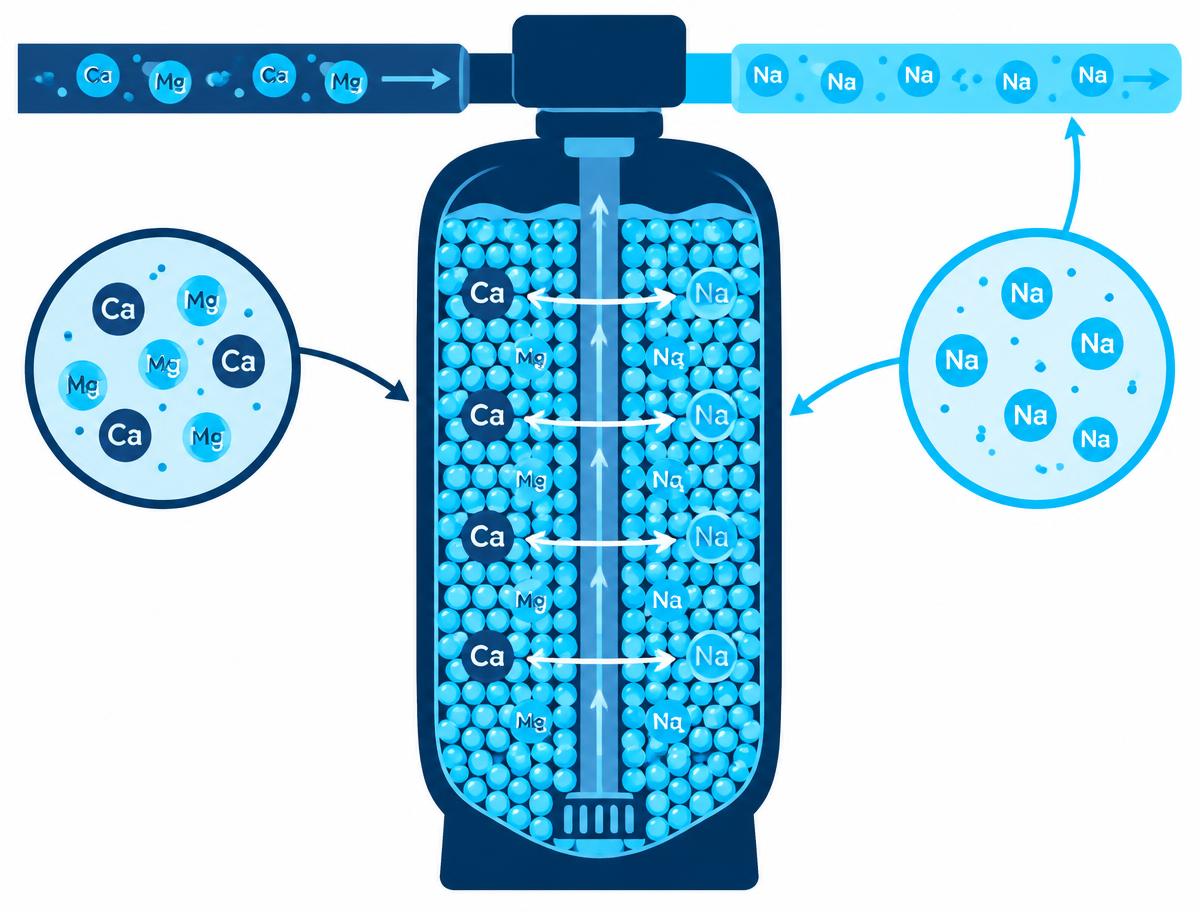
Hardness may be reported in grains per gallon or milligrams per liter as calcium carbonate. Approximately 17.1 milligrams per liter as calcium carbonate equals one grain per gallon. Keep the units attached to every result. A total dissolved solids meter is not a direct softener performance test because conventional ion exchange does not simply remove all dissolved material. The softener operation explanation helps clarify why hardness, salt use, regeneration, and general dissolved-solids readings should not be treated as interchangeable indicators.
Separate a service question from a replacement decision
A softener that is not meeting expectations may have a settings issue, depleted salt, an operating problem, an obstructed component, or a condition that requires more substantial work. These are possibilities for assessment, not diagnoses that can be made from an article. A technician should relate the observed symptoms to the model's operation and actual measurements. Ask what finding supports the proposed repair, how the work will be verified, and whether other known issues remain. Service is most useful when it addresses an identified cause rather than substituting parts without a clear explanation.
Replacement deserves comparison when the condition, repair scope, parts availability, service support, capacity, or installation arrangement no longer fits the household's needs. Age is relevant context, but it is not the only criterion and does not establish a universal replacement deadline. A newer system can be poorly matched or neglected, while an older one may still perform usefully. Compare a written service scope with a written replacement scope, including what each option leaves unchanged. The question is not merely whether the old tank can keep operating, but whether the chosen investment makes sense for the household.
Compare repair and replacement with explicit hypothetical scenarios
In a hypothetical Maple Grove home, an inherited softener might produce an appropriate treated-hardness result after a documented maintenance issue is corrected. If its condition, capacity, parts support, and installation remain suitable, the household could reasonably compare continued service with replacement rather than assuming a purchase is necessary. This example is not a local customer story and does not promise that maintenance will restore any particular unit. It shows how measurements and a specific finding can change the decision.
In another hypothetical household, an old system might require substantial repair while also failing to match changed occupancy and simultaneous fixture demand. Replacement could then be worth evaluating, especially if the installation needs work regardless of the equipment choice. A third household might find that softening has little value for its priorities and choose not to reinvest. None of these outcomes can be selected from age or appearance alone. A sound assessment preserves the option to service, replace, defer, or remove equipment as appropriate rather than treating every inspection as a sales conclusion.
Recheck household demand instead of copying the old model
An existing softener's size is evidence of a previous choice, not proof that the same size is right today. Occupancy, daily water use, fixture overlap, and measured hardness may differ from the assumptions used when it was installed. Ask the provider to explain both daily hardness load and simultaneous service flow. A system's usable capacity at its intended settings differs from a simple advertised rating, while peak-flow performance depends on the exact equipment and plumbing conditions. Copying the old tank dimensions skips those questions.
Consider outdoor connections as part of this review. If irrigation or hose use passes through the softener, it may affect operating demand without serving the indoor purpose the household intended. Verify the actual branch arrangement before proposing changes. The same care applies to a separate drinking-water supply and any appliance-specific requirements. A conventional sodium-regenerated softener can add sodium, so dietary questions should be discussed with an appropriate healthcare professional. A useful replacement plan explains what water will be treated, why, and what tradeoffs the household is accepting.
Do not assume existing connections can all be reused
A replacement may appear simple because supply pipes and a drain are already nearby. Each connection still deserves review for condition, compatibility, manufacturer instructions, and applicable requirements. Ask whether existing bypass valves, flexible connections, drain tubing, and fittings are suitable for reuse. A quote described only as swap the unit may conceal important differences in scope. It should be clear which components are new, which remain, and what additional work could become necessary when the old equipment is removed.
Drainage is a functional installation requirement, not an incidental hose route. The installer should identify an appropriate discharge arrangement and applicable air-gap or backflow provisions. Review electrical needs, accessible shutoffs, equipment stability, and clearance around other mechanical equipment. Ask who handles any required permit or inspection and how startup will be documented. Existing work is not automatically compliant merely because it has been present for years. Conversely, do not assume every old component needs replacement without a reason. The scope should follow an actual assessment.
Audit the kitchen equipment as its own system
A newly purchased home may include an under-sink filter, a reverse osmosis unit, a refrigerator filter, or several overlapping stages. Identify the purpose and model of each before buying replacement cartridges. If service dates are unknown, consult the manufacturer or a qualified service provider about an appropriate return-to-service and maintenance plan rather than assuming the equipment is ready because water comes out. Check the faucet, tubing, shutoffs, cabinet access, and any storage tank. A functioning softener does not establish the condition of the kitchen system.
Carbon and reverse osmosis serve different documented goals, and neither category automatically guarantees a particular PFAS reduction. If a specific substance matters to the household, compare the exact model's applicable independently verified claims, capacity, operating limits, and replacement requirements. If taste is the priority, describe that preference directly. The reverse osmosis and carbon guide can help organize the comparison. An inherited arrangement with many stages may be appropriate, redundant, poorly maintained, or unnecessary; the number of housings alone does not establish its value.

Make maintenance access part of the equipment audit
The route to a salt tank matters when someone must carry bags through a finished basement or reach around stored items. Check the lid opening, refill height, floor access, and the ability to work safely beside the equipment. Under a kitchen sink, evaluate whether a cartridge can be removed without dismantling a pullout shelf or disturbing unrelated plumbing. A compact installation can still be inconvenient if it leaves no working space. Equipment that is easy to neglect because it is difficult to reach is not necessarily a practical fit.
Ask for the maintenance tasks associated with each proposed option, including salt checks, appropriate cleaning or sanitizing, filter changes, and any membrane or tank procedures. Follow the selected manufacturer's requirements rather than assuming every system needs the same annual service. Replacement timing can depend on model, water conditions, use, and rated capacity. Taste and appearance are not reliable verification of ongoing reduction performance. Put the records in a shared household location and identify who will perform each task so maintenance does not disappear between the move-in checklist and daily life.
Build a budget that distinguishes equipment from corrective work
Use the current pricing page as the budget starting point rather than a fixed dollar figure in an article. Ask a service proposal to identify the assessment, labor, parts, and any limits on the expected outcome. Ask a replacement proposal to identify equipment, removal, installation changes, startup, and optional stages. Clarify what happens if the assessment reveals another issue. Written scopes make it easier to compare the actual choices instead of contrasting a minimal repair with an all-inclusive replacement and assuming the price difference reflects equipment quality alone.
Include operating considerations such as salt, regeneration water, replacement cartridges, anticipated service tasks, and the household's time. Do not assume that replacement will pay for itself, guarantee lower utility bills, or eliminate all spotting. Those outcomes depend on conditions and should not be promised without an appropriate basis. The product overview can help distinguish functions before comparing proposals. A phased plan may prioritize necessary installation corrections or a useful repair while deferring a kitchen upgrade. Deferral can be a reasonable decision when no urgent or documented need supports the added equipment.
Close the audit with a verified plan, not just a new purchase
Whether the outcome is service or replacement, ask for the resulting settings, relevant measurements, and operating instructions to be recorded. Confirm the bypass and shutoff arrangement, normal regeneration behavior, and the observations that should prompt a call. If equipment is intentionally left out of service or removed, document the plumbing state and any remaining components. A home record should explain what the system does today, not preserve a confusing collection of old manuals and disconnected housings that the next owner must interpret.
Bring the inventory, photographs, service history, measurements, and ranked goals to a discussion through the contact page. Treat that as a way to organize questions, not as confirmation that a request was received or an appointment is scheduled. Maple Grove's mix of existing homes and newer construction makes both inherited-equipment review and first-installation planning relevant. The useful outcome is a system arrangement the household understands, can maintain, and actually values, with no assumption that groundwater requires a standard package or that an older softener automatically belongs in the replacement queue.
Sources and further reading
Reviewed October 22, 2026. Utility reports describe the public supply, not an individual household sample. Check the utility for current reports and notices. Images are illustrative, not photographs of a customer installation.
Frequently asked questions
Should I replace the softener immediately after buying a Maple Grove home?
Not automatically. Identify the model, service history, installation arrangement, incoming hardness, and treated-water performance before deciding. An unfamiliar system may need orientation or service rather than replacement, while a system that appears normal may have unresolved issues. Compare condition, parts support, household demand, and installation requirements. A property purchase is a good reason to audit the equipment, not proof that all inherited treatment should be replaced.
How can I tell whether service is worth comparing with replacement?
Ask for a specific assessment finding, a written repair scope, and an explanation of how operation will be checked afterward. Then compare the repair with replacement, including issues each option leaves unchanged. Condition, capacity, parts availability, service support, and installation work all matter. Age alone does not establish a universal deadline, and an article cannot determine whether a particular valve, resin bed, or control should be repaired.
Does a softener loop mean my new home is ready for any softener?
No. A loop is only part of the installation picture. Verify which branches it serves, available space, drainage, electrical access if needed, and maintenance clearance. The selected system's dimensions and operating requirements still apply. Ask the builder or plumber to explain the intended arrangement and have the installer identify any additional work rather than assuming capped pipes guarantee a simple installation.
Can I reuse an inherited reverse osmosis system without knowing its service history?
Do not assume it is ready solely because water flows from the faucet. Identify the exact model and consult its manufacturer or a qualified service provider about inspection, replacement parts, cleaning or sanitizing, and return-to-service procedures. Check the tubing, shutoffs, storage arrangement, and intended performance goal. Unknown service history is a reason to verify the system, not a basis for claiming that the water is unsafe.
What should be included in a Maple Grove equipment-audit discussion?
Include model photographs, manuals, known service dates, incoming and treated-hardness results with units, a branch diagram if available, and the household's priorities. Add space measurements, drain and electrical observations, outdoor connections, and any kitchen treatment. Separate documented facts from guesses. This helps compare service, replacement, selective upgrades, or deferral without assuming that every visible component should be retained or every old component should be discarded.
More from the blog
Does a City-Softened Minneapolis Home Need Extra Water Treatment?
Minneapolis already softens its municipal water. Here is how to decide whether additional household treatment serves a real purpose.
Saint Paul Drinking-Water Taste: Kitchen Filter or Main-Line Treatment?
A kitchen taste preference and a whole-home treatment goal are different projects. Learn how to compare them in an existing Saint Paul home.
Bloomington Water Treatment for Houses and Condos: Know Your Plumbing
Bloomington's combined municipal supply is only part of the decision. Your plumbing boundary and maintenance authority determine which options fit.
Edina or Morningside? Plan the Right Water Treatment for Your Remodel
Edina's two water systems make address-level planning important. Learn how to connect your supply, household measurements, and kitchen remodel decisions without assuming every home needs the same equipment.
Talk through your water with a local pro
A free phone consultation starts with your water source and your goals. Published installed pricing, kitchen reverse osmosis included with every whole-home package, and a best-price guarantee.