
Minnesota Water Pros blog
Eagan, Minnesota · Local service informationEagan Water Treatment: Kitchen Taste, Laundry, and Everyday Upkeep
Published October 22, 2026 · 12 min read · Educational content only, not a water quality diagnosis.
In this guide
- Use Eagan's annual drinking-water information as the public-supply starting point, while recognizing that a utility report does not measure conditions at every household faucet.
- Separate hardness-related shower and laundry goals from kitchen taste preferences or a specific drinking-water reduction goal before comparing equipment.
- Describe real morning overlap, including showers, sinks, and appliances, so an installer can evaluate service flow and pressure rather than household size alone.
- Compare softening, carbon filtration, and reverse osmosis by their different purposes, documented performance, installation requirements, and recurring maintenance.
- Build a practical budget around the smallest justified treatment scope, written installation details, replacement supplies, and a manageable service schedule.
What EWG's Tap Water Database Shows for Eagan
The Environmental Working Group (EWG) compiles utility testing results supplied by the Minnesota Department of Health. Its listing for the Eagan water system, which EWG shows serving about 68,223 people from groundwater with data from 2015 to 2023, reports 18 contaminants detected, 10 of them at levels above EWG's health guidelines. The largest gaps EWG lists are Haloacetic acids (HAA9) (about 98 times the guideline), Total trihalomethanes (TTHMs) (about 70 times the guideline), and Bromodichloromethane (about 48 times the guideline). Several of the listed items are disinfection byproducts, which form when the chlorine that keeps water safe in the pipes reacts with natural organic matter. We reviewed this listing on October 22, 2026, and you can read the full breakdown on [EWG's Eagan page](https://www.ewg.org/tapwater/system.php?pws=MN1190007).
Context matters. EWG's guidelines are its own health benchmarks and are often far stricter than federal legal limits, and many of the listed substances have no legal limit at all. For the most recent quarter EWG reports from the U.S. EPA (April to June 2024), this system was in compliance with federal health-based drinking water standards. Utility data describes the public supply, not the water at your tap, so it is a starting point for a conversation rather than a verdict on your home. If any listed item matters to your household, match it to equipment certified to reduce that specific substance, and compare the Minneapolis and St. Paul snapshots on our water quality page.
Start with Eagan's water source, not a neighborhood assumption
Eagan's published drinking-water report describes groundwater drawn from multiple aquifers. For a municipally supplied home, the city's annual drinking-water information is the appropriate place to begin. Groundwater origin is useful context, but it does not establish the hardness at your kitchen sink or demonstrate that a particular filter is necessary. Nor does a home's proximity to a lake establish its indoor water source. Confirm the utility serving the property, identify any existing treatment, and keep the report's sampling period attached to the information you use. A report describing earlier monitoring should not be presented as a measurement taken at your home today.
The most useful first conversation is about what happens in your house. Perhaps the coffee kettle develops deposits, the shower door needs frequent cleaning, or the drinking water has a taste you would prefer to change. Those are different observations, and they do not all point to the same equipment. Write down the fixture, whether the issue occurs with hot or cold water, and when you notice it. Our Eagan service-area overview can help frame the local discussion, but household measurements and plumbing details should determine the actual treatment plan. Appearance, smell, and taste are not reliable substitutes for testing a specific water-quality concern.
Map the morning before choosing equipment
A household's busiest fifteen minutes can matter more to equipment selection than its average day. Consider a hypothetical Eagan family in which two people shower while someone fills a kettle and a washing machine begins its cycle. This is an example, not a claim about local households. If all those fixtures draw through a main-line treatment system, the installer needs to evaluate their combined demand, the available pressure, pipe size, and the selected equipment's pressure loss. Simply counting residents misses these details. Ask how the proposed system performs while several fixtures operate together, rather than accepting an unexplained tank size or a marketing description such as high capacity.
Make a short schedule showing the overlap you actually want to support. Include occasional demands, such as guests using another bathroom, but do not inflate the plan around an unlikely maximum. Identify outdoor faucets and irrigation connections so the installer can determine whether they bypass indoor treatment. Also note any existing pressure complaints before treatment is added. A filter cannot correct every restriction in old plumbing, and a larger treatment vessel is not automatically the answer to a pressure problem. If the home already has equipment, ask whether the apparent bottleneck is a clogged cartridge, an undersized valve, a plumbing restriction, or something else that requires a different repair.
- Record which showers, faucets, and appliances normally overlap during the busiest morning period, including any existing pressure changes.
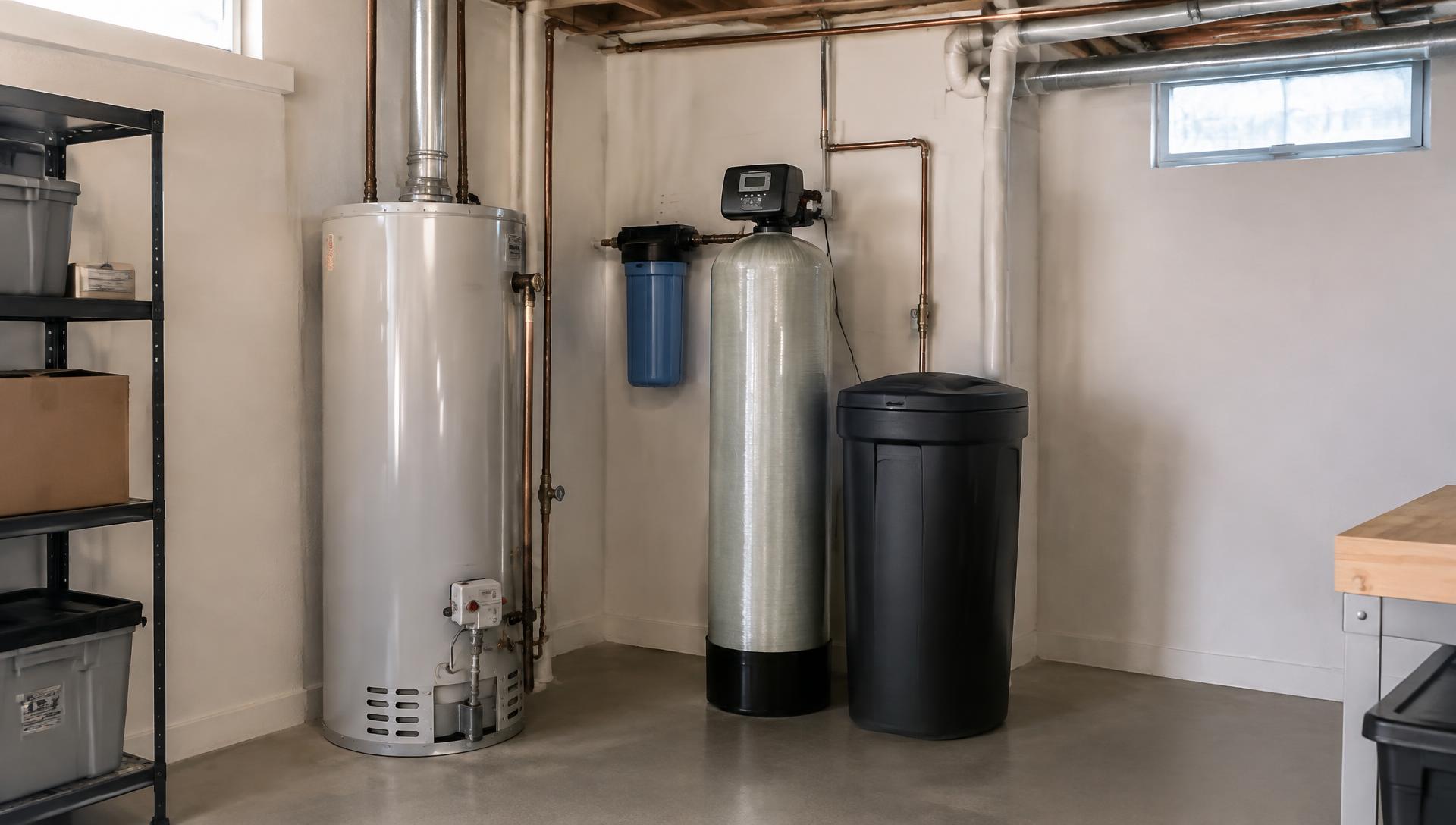
- Photograph the incoming water line, existing equipment labels, bypass valves, drain location, and the space available for future service.
- List kitchen goals separately from shower, laundry, and whole-home goals so each proposed stage has a clear purpose.
- Identify who will refill salt, replace filters, check for leaks, and arrange service before deciding that an upkeep schedule is manageable.
Measure hardness where it answers a useful question
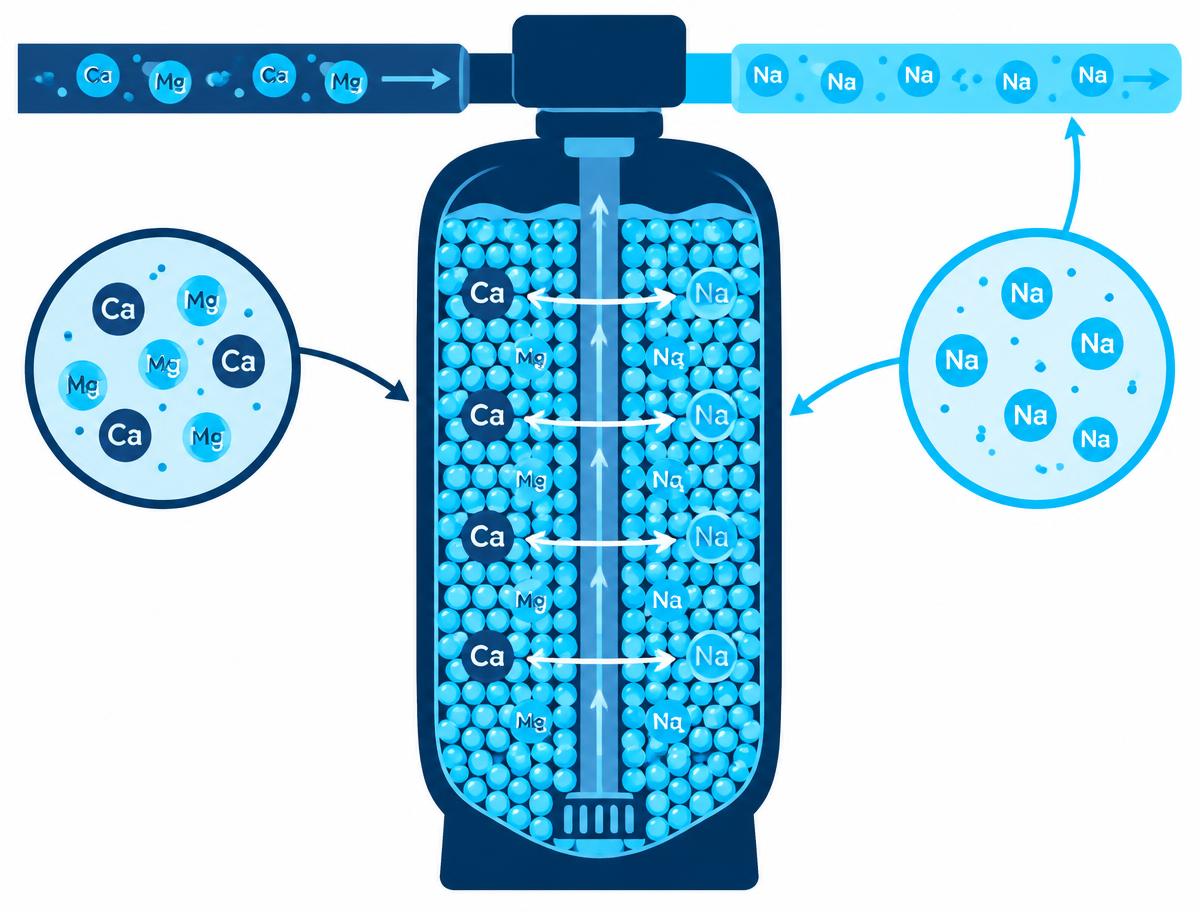
Hardness primarily reflects dissolved calcium and magnesium. A household softener reduces those hardness minerals through ion exchange; it is not a universal water purifier. Minnesota Department of Health guidance treats softening as a household choice rather than a general requirement for safe drinking water. Measure incoming hardness before deciding whether the expected convenience matters to you. Record the result and its units. Hardness commonly appears as grains per gallon or milligrams per liter as calcium carbonate, and one grain per gallon is approximately 17.1 milligrams per liter. Comparing numbers without their units can lead to a very different equipment setting than intended.
If a softener is already installed, paired samples can help distinguish the untreated supply from equipment performance. Ask the installer to identify a suitable sampling point before treatment and another after treatment, rather than assuming every faucet follows the same route. An outdoor tap may bypass the softener, but that must be verified. Keep the system's bypass position and recent regeneration history with the results. A softened-water measurement alone cannot tell you the incoming hardness, and a single unexplained result should not become a replacement recommendation. The softener operation guide explains why hardness settings, resin capacity, and regeneration belong in the same discussion.
Keep kitchen goals separate from laundry goals
Laundry and kitchen water share a supply, but they do not necessarily need the same treatment. A homeowner may want less mineral buildup at fixtures while being satisfied with drinking-water taste. Another may mainly want a dedicated kitchen tap and have no interest in treating the laundry supply. Softening can address measured hardness throughout connected indoor plumbing, but it does not automatically meet a specific drinking-water contaminant-reduction goal. Conversely, a small under-sink filter does not soften the shower or change the water entering the washing machine. Start with the location of the desired improvement, then choose the treatment category that actually reaches that location.
For laundry concerns, avoid assuming that every stiff towel or residue mark is caused by hardness. Detergent amount, rinse settings, loading, and appliance condition can also influence the outcome. Use the hardness measurement alongside the appliance manufacturer's instructions before changing several things at once. If you install a softener, adjust detergent cautiously according to product guidance rather than expecting a guaranteed reduction in use. For kitchen concerns, describe whether the goal is taste, kettle deposits, or reduction of a named substance. Those distinctions make it easier to compare a focused system without turning an ordinary preference into an unsupported claim about water safety.
Compare carbon filtration and reverse osmosis precisely
Carbon filtration can be appropriate for documented taste-and-odor goals, but performance depends on the media, system design, flow, and conditions of use. A generic carbon label does not prove reduction of PFAS or any other named substance. Request the exact model's performance sheet and, where a certification is claimed, confirm that the listing covers the specific reduction claim. Capacity matters as well: a cartridge may have different rated service lives for different claims. If the household wants only a change at the drinking tap, treating every gallon entering the home may add cost and upkeep without advancing that particular goal.
Reverse osmosis uses a membrane and associated stages to treat a smaller drinking-and-cooking supply. Its documented capabilities must still be checked model by model. Do not infer every possible reduction from the words reverse osmosis, and do not use a low dissolved-solids reading as proof that every contaminant has been addressed. Review production rate, storage or dispensing design, incoming pressure requirements, replacement elements, and the drain connection. The comparison of reverse osmosis and carbon filters is a useful starting point when two kitchen products appear similar but use different treatment processes. The final choice should follow your stated goal, not the number of stages advertised.

Design an upkeep routine that survives a busy week
Maintenance should be part of selection, not an instruction sheet discovered afterward. For a salt-based softener, ask how salt level is checked, what salt the manufacturer specifies, how bridging is recognized, and which settings the homeowner should leave alone. Regeneration uses water and salt, and actual use depends on hardness, demand, programming, and equipment efficiency. Avoid a quote that promises the same operating costs for every household. Find out how a power interruption affects the clock or settings, how the bypass operates, and which signs justify a service call. The system should remain accessible without moving stored belongings or reaching across unsafe obstructions.
For a kitchen filter, establish both a calendar reminder and a way to track capacity if the manufacturer requires it. Reduced flow or a return of taste may signal a problem, but the absence of those changes does not prove that a cartridge still meets a specific reduction claim. Follow the stated replacement conditions and sanitation procedure. Ask whether the homeowner can change elements safely, which parts require professional service, and where exact replacements are available. Keep the model number, installation date, cartridge identifiers, and service instructions together. A modest system with dependable upkeep is a more coherent choice than a complicated arrangement whose maintenance repeatedly gets postponed.
Check the installation details before comparing totals
At the main line, review shutoff access, bypass access, pipe support, available space, and clearance for lifting lids or replacing media. A softener's drain connection needs appropriate installation, including required backflow protection and an air gap where applicable. Ask the installer to explain local code and permit requirements rather than improvising a drain arrangement. Electrical needs depend on the selected equipment. At the kitchen, check cabinet dimensions, disposal clearance, faucet-hole options, and whether a refrigerator connection is included. An under-sink system can fit physically yet remain difficult to service if cartridges cannot be removed without disconnecting unrelated plumbing.
A written proposal should identify the model, intended purpose of each stage, plumbing work, testing, startup, and homeowner orientation. It should also state what is excluded. A kitchen faucet, refrigerator connection, pressure correction, or modification to an existing drain may not be part of a basic equipment description. Ask how the installer will verify performance after startup and what records you will receive. Hardness reduction can be checked with appropriate before-and-after measurements, while a specific contaminant concern may require a different sampling plan and laboratory method. These are different kinds of verification, and neither should be replaced with a vague promise that the water will be better.
Use a staged budget instead of buying every category
Begin with your highest-priority outcome and decide what can wait. In a hypothetical household whose only concern is drinking-water taste, an appropriately documented kitchen filter may be a more focused first project than main-line treatment. In another hypothetical household with measured hardness and frequent fixture-cleaning complaints, softening may deserve the first evaluation while kitchen filtration remains optional. These examples illustrate decision order, not expected results or guaranteed savings. Compare current options on the pricing page rather than relying on copied prices that may omit site-specific work. Ask for equipment, installation, consumables, and service assumptions to be separated clearly.
Include recurring purchases and household effort in the budget. Salt storage, cartridge availability, membrane replacement, service visits, and water used during treatment can all matter, depending on the system. Do not count on an appliance lasting a specified number of additional years or on detergent savings paying for the purchase. Those outcomes are too dependent on the household to promise. Review the product catalog after the treatment scope is clear, then compare only products that address that scope. If existing equipment works acceptably, inspection or adjustment may be a reasonable first expense instead of adding a new treatment stage simply because space is available.
Bring a short evidence packet to the next conversation
- Bring the city report you used, including its reporting year, plus any relevant utility notices and household test results with sampling locations.
- Include an incoming hardness result with units, existing equipment model numbers, service history, and notes about bypass positions.
- Describe the busiest morning overlap and rank kitchen, shower, laundry, and maintenance goals instead of presenting them as one undifferentiated concern.
- Ask for written performance claims, installation inclusions, replacement-part identifiers, maintenance intervals, warranty terms, and a startup verification plan.
The next step does not need to be a purchase. Confirm the supply connection, take useful measurements, and decide which daily task you most want to improve. You can use the contact page to start a discussion with Minnesota Water Pros, but a conversation is not a diagnosis or a guarantee that a particular installation is appropriate. Keep immediate utility instructions separate from optional home-treatment planning. A good Eagan plan connects the city's groundwater context with your actual plumbing, morning schedule, kitchen priorities, and willingness to maintain equipment. That is more useful than selecting the largest package or assuming every household on the same street needs the same solution.
Sources and further reading
Reviewed October 22, 2026. Utility reports describe the public supply, not an individual household sample. Check the utility for current reports and notices. Images are illustrative, not photographs of a customer installation.
Frequently asked questions
Does Eagan's groundwater supply mean every home needs a softener?
No. Groundwater origin is context, not a household equipment prescription. Measure incoming hardness and decide whether hardness-related maintenance or preferences justify softening. Minnesota Department of Health guidance treats softening as a personal household choice. If you already have a softener, compare suitable before-and-after samples and review its settings before assuming replacement is necessary.
Can one kitchen filter improve laundry water too?
An under-sink filter generally treats only its connected drinking-water outlet and any specifically connected appliance. It does not change the supply to the washing machine or shower. If laundry is the priority, first check hardness, detergent use, appliance instructions, and the plumbing layout. Choose treatment at the point that actually serves the fixtures involved.
How should we describe busy morning demand to an installer?
List the fixtures that genuinely operate together, such as two showers and a washing machine, and describe existing pressure problems. The installer should evaluate flow, pressure loss, pipe size, and equipment specifications together. Household size alone is not a complete sizing method, and oversized equipment is not automatically the best answer to a pressure complaint.
Does a carbon filter automatically reduce PFAS?
No. Ask for the exact model's documented claim, rated capacity, operating conditions, and independent listing when certification is represented. Carbon products differ, and a taste-and-odor claim does not establish PFAS reduction. A softener also should not be treated as a substitute for equipment documented for a specific drinking-water reduction goal.
What maintenance information should come with a proposal?
Request replacement intervals, exact consumable identifiers, salt guidance where relevant, sanitation instructions, service access requirements, and recurring cost assumptions. Ask what you can maintain yourself and what requires professional service. A clear maintenance plan should also explain bypass operation, leak response, recordkeeping, and how performance will be checked after installation.
Should we buy kitchen filtration and softening together?
Only if each stage addresses a justified goal and the combined installation fits your budget and upkeep capacity. Kitchen preferences and whole-home hardness are separate decisions. A staged project can be reasonable, especially when you want to evaluate one change before adding another. Use current pricing and a written scope rather than assuming a package creates savings.
More from the blog
Does a City-Softened Minneapolis Home Need Extra Water Treatment?
Minneapolis already softens its municipal water. Here is how to decide whether additional household treatment serves a real purpose.
Saint Paul Drinking-Water Taste: Kitchen Filter or Main-Line Treatment?
A kitchen taste preference and a whole-home treatment goal are different projects. Learn how to compare them in an existing Saint Paul home.
Bloomington Water Treatment for Houses and Condos: Know Your Plumbing
Bloomington's combined municipal supply is only part of the decision. Your plumbing boundary and maintenance authority determine which options fit.
Edina or Morningside? Plan the Right Water Treatment for Your Remodel
Edina's two water systems make address-level planning important. Learn how to connect your supply, household measurements, and kitchen remodel decisions without assuming every home needs the same equipment.
Talk through your water with a local pro
A free phone consultation starts with your water source and your goals. Published installed pricing, kitchen reverse osmosis included with every whole-home package, and a best-price guarantee.